What an Outsourced Operations Department Can Handle

Back-office capacity should grow without drawing core teams into routine administration. An outsourced operations department can handle repeatable tasks such as invoice processing, scheduling, payment follow-ups, payroll preparation, employee onboarding administration, and reporting. A typical team takes four to eight weeks to reach steady-state productivity, with onboarding and process documentation forming the initial phase.
The challenge is rarely whether a task can be moved. It is whether the process is defined, controlled, and measured well enough to avoid creating new friction. In Saudi Arabia, the right boundary depends on workload, process maturity, system access, and how closely each task connects to internal approvals. This guide explains which back-office functions suit an outsourced operations department, what affects costs, and how to plan onboarding and measure performance. It also covers how to retain decision authority and protect the work that differentiates your business. The result is a clearer operating boundary: routine execution can scale while leadership attention stays focused on growth and customer outcomes.
Key Takeaways
- Set service levels, reporting expectations, and escalation paths before work transfers; use regular reviews to identify performance gaps early.
- Keep strategic decisions and differentiating work close to leadership, while assigning repeatable processes with clear procedures and approval boundaries.
- Assess operational cost reduction through workload alignment, process simplification, and the ongoing effort required to manage outsourced work.
- Define who leads, executes, and approves each process so responsibilities remain clear as workload and team capacity change.
Table of Contents
1. Costs, onboarding timelines, and performance metrics
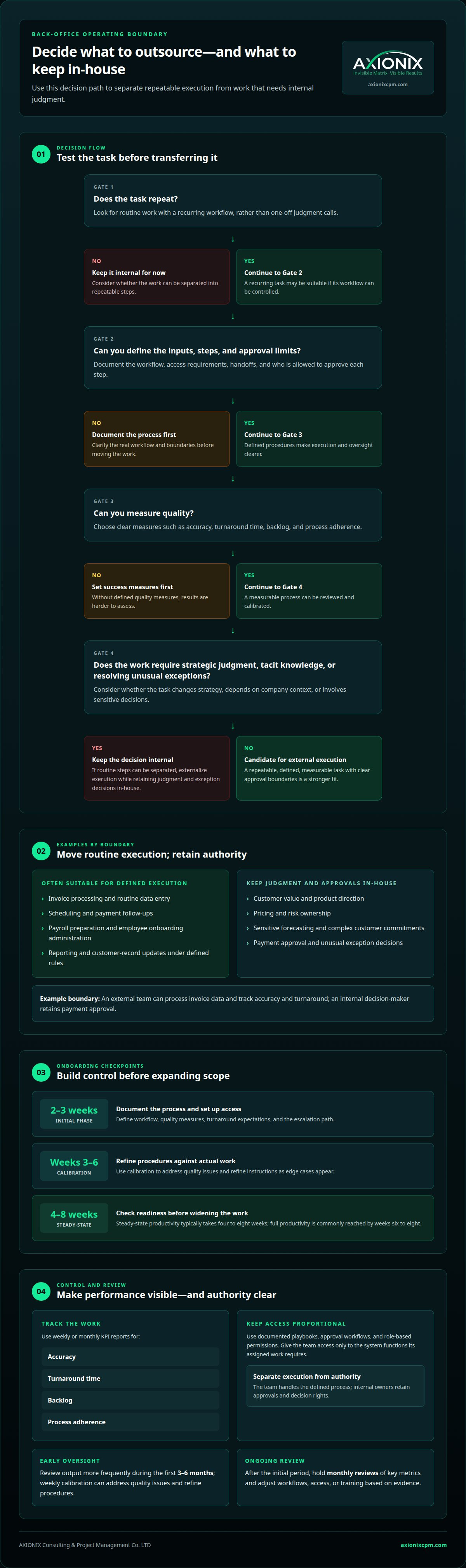
What steps are involved in outsourcing business operations? Define the process, document its workflow, access requirements, quality measures, turnaround expectations, and escalation path. Then onboard the team, calibrate its work, and review results. This sequence establishes a controlled boundary before routine tasks move to an outsourced operations department.
Start with a clearly defined, high-volume process and straightforward success measures. During the first two to three weeks, onboarding typically covers process documentation and access setup. The team then calibrates during weeks three through six, refining procedures against actual work. Steady-state productivity typically takes four to eight weeks, while full productivity is commonly reached by weeks six to eight. Treat these stages as checkpoints: confirm that documented procedures reflect real workflows before expanding the scope.
Costs depend on process volume, complexity, required coverage, system access, and management oversight. The price depends on the case and is provided after a quote request; these factors shape the required scope and resourcing. Compare the full operating model, not just task execution: internal time spent on approvals, exceptions, and quality checks also affects the workload. A process with frequent exceptions may need more coordination than a standardized administrative task.
Set service levels, transparent reporting, and clear escalation paths before launch. Use weekly or monthly KPI reports to track accuracy, turnaround time, backlog, and process adherence. Review output more frequently during the first three to six months, then hold monthly reviews of key metrics. Weekly calibration sessions can address quality issues and refine procedures as the team encounters edge cases.
Manage access and compliance through documented playbooks, approval workflows, and role-based permissions. Give the team access only to the system functions its assigned work requires. For example, an invoice process can track accuracy and turnaround while reserving payment approval for an internal decision-maker. This separates execution from authority and makes performance visible. When results fall short, adjust the workflow, access boundary, or training based on specific evidence rather than assumptions.
2. Focus on core business activities
An outsourced operations department creates capacity when it removes friction without transferring strategic judgment. Keep decisions about customer value, product direction, pricing, and risk ownership within the business. Move repeatable execution when its steps and approval limits can be defined. For example, a team may handle routine data entry while internal leaders interpret the resulting reports and decide what action to take.
Map work by decision type, not department name. A finance function may include routine document preparation and sensitive forecasting. The first can follow a documented workflow; the second depends on company context and executive judgment. Similarly, customer records can be updated according to defined rules, while complex customer commitments may need an internal specialist. This distinction protects expertise and clarifies who owns the outcome.
Use a practical boundary test for each process: does the task repeat, can you define its inputs, and can you measure quality? If so, it may suit external execution. If the work changes strategy, resolves unusual exceptions, or depends on tacit knowledge, retain the decision internally. Start with one process, then map handoffs between the external team and internal owners. Clear handoffs prevent duplicated effort and missed approvals.
Capacity also depends on the shape of the workload. Business process outsourcing can help an organization scale operations up or down as market demand changes. But when an operations VA works forty hours per week, the economics of outsourcing versus employing begin to shift. Compare management effort, training burden, continuity needs, and exception volume, not just the hours transferred. An outsourced operations department should absorb repeatable work, not become another layer of internal coordination.
For a structured view of which activities belong inside or outside, explore business activity analysis as part of defining the operating boundary.
3. Operational cost reduction
How do outsourced operations compare with in-house departments? Outsourcing moves repeatable execution and some management effort outside the organization, while internal teams retain decision authority and oversight. Compare the full operating cost, including employee time spent training, correcting errors, managing exceptions, and coordinating handoffs. When an operations VA works forty hours per week, the economics of outsourcing versus employing begin to shift.
Reduce costs by matching capacity to workload, not by moving tasks indiscriminately. First, identify routine work that uses internal hours but does not require strategic judgment. Next, map unnecessary process steps and remove them before transferring the work. For example, standardizing invoice data entry can reduce rework, while keeping payment approval with an internal manager preserves control.
Technology investment can lower long-term costs when it eliminates repeated manual effort. Some outsourced operations companies use artificial intelligence and machine learning to improve workflow efficiency, reduce errors, and increase accuracy. Evaluate the process itself first: automation cannot fix unclear instructions or inconsistent inputs. Track rework, turnaround, and exception volume to see whether a change reduces total effort.
How do you choose an outsourced operations provider? Define the process, quality measures, reporting, access boundaries, and escalation route, then assess whether the operating model fits your workload. For a Saudi-based business, align service arrangements with the work’s data, systems, and internal approval structure.
What laws and regulations apply to outsourced operations in Saudi Arabia? Applicable obligations depend on the operation, workforce arrangement, data handled, and industry. Identify the requirements relevant to the specific activity and jurisdiction before transferring regulated work, and establish who owns compliance decisions and records.
What are the risks of outsourcing operations, and how can they be managed? Common risks include declining quality, excessive access, unclear ownership, and work backlogs. Use documented procedures, role-based permissions, defined escalation paths, and scheduled performance reviews to manage them. Keep business-critical approvals internal, and monitor exceptions alongside routine output. Cost reduction is sustainable only when oversight and process design remain part of the model.
4. Operations team roles and responsibilities
A minimum viable outsourced operations team typically has two people: a team lead and an operations VA. The lead coordinates workflow, communicates priorities, and manages escalations. The VA completes documented tasks and records exceptions. Depending on workload, the team may include one or two operations VAs, adding execution capacity without blurring accountability.
Assign each process an owner, an executor, and an approver. For accounts receivable, an operations VA can generate invoices, schedule deliveries, follow up on customer payments, and apply received payments. An internal approver can retain authority over disputed balances or exceptions. This division keeps routine administration moving while preserving control over consequential decisions.
Payroll support also depends on clear role boundaries. An outsourced specialist can check timesheet accuracy, enter routine data, and prepare payroll runs to the business’s specifications. The authorized internal role reviews and approves each prepared run. For employee transitions, the team can manage onboarding checklists and archive employee files during offboarding. Documented procedures make each handoff traceable.
Give the team a practical operating rhythm. A weekly team standup covers work updates, upcoming commitments, and blockers. The business owner or operations contact can hold a weekly priorities sync with the team lead. These separate meetings connect daily execution with shifting business priorities and surface capacity constraints before tasks accumulate.
Equip each role with documented standard operating procedures, approval workflows, and quality standards. Audit-ready reporting helps specialists track process adherence and manage compliance risk. Role-based system permissions should limit access to the functions needed for assigned work. Reliable performance depends on matching authority, access, and responsibility. For example, preparing invoices does not require payment-approval permissions.
Define the team structure and accountability model through operations as a service, aligning roles with the processes being transferred.
AXIONIX Consulting & Project Management: Operations as a Service (OaaS)
AXIONIX Consulting & Project Management provides Operations as a Service (OaaS) for businesses that need operational capacity organized around defined processes. Its integrated approach connects operational capabilities through a shared operating fabric rather than treating each task as an isolated handoff.
Turn to OaaS when repeatable work needs coordinated execution, or when internal teams need stronger operating infrastructure without adding unnecessary organizational layers. AXIONIX Advisory offers Business Consulting to clarify the operating model and Transformation to support changes in how work is structured. AXIONIX Studies offers Feasibility Studies to assess a proposed operational direction before implementation.
The useful starting point is a specific operational constraint: a recurring backlog, disconnected workflows, or limited capacity for routine execution. Define the work and the outcome required, then consider which operating structure fits. To discuss your operational requirements, visit axionixcpm.com.
Design the Next Operating Model
The next step is not simply to outsource more. It is to design an operating boundary that can adapt as priorities shift. Treat an outsourced operations department as part of the wider system: define how work enters, where decisions remain, and how internal teams respond to exceptions. This structure makes delegation an intentional capability rather than a disconnected handoff.
AXIONIX Consulting & Project Management Co. LTD offers Operations as a Service (OaaS), Business Consulting, and Transformation to help businesses shape their operating model. These offerings fit when the challenge extends beyond task execution to designing or adjusting the operational structure. Start with the constraint that matters most, then define the role of integrated operational infrastructure in addressing it.
Explore your operating model with AXIONIX Consulting & Project Management Co. LTD. A deliberate next step can create room for your teams to focus on the work that moves the business forward.
Frequently Asked Questions
What Can Be Outsourced in Back Office Operations?
Repeatable administrative processes can be assigned to an outsourced operations department when their inputs, outputs, and approval boundaries are clear. Examples include routine payroll preparation, invoice generation, payment follow-ups, employee onboarding checklists, and report preparation. A practical test is whether someone can follow documented steps and identify an exception without making a strategic decision. Keep approvals and sensitive judgment with designated internal owners.
Why Hire Oursourced Operations Help?
Businesses use external operational capacity to reduce routine workloads for internal teams and adjust execution capacity as demand changes. For example, a seasonal rise in customer payment follow-ups may require more processing support without changing who owns customer relationships. The value depends on how efficiently the work can be coordinated. Include handoff time, oversight, and exception management when assessing the operating model.
Which business operations can be outsourced?
Suitable operations include finance administration, routine data handling, scheduling, selected technical support, and employee administration. Set the boundary according to the work, not just the department: preparing a report can be routine, while interpreting its implications may require internal business knowledge. Identify decision points first, then assign execution, review, and exception ownership to keep the workflow connected to core activities.
What services do outsourced operations providers offer in Saudi Arabia?
In Saudi Arabia, outsourced operational support can cover administrative finance tasks, payroll preparation, employee records, scheduling, and reporting. Some arrangements also include technical support or coordinated operational teams. The right scope depends on the process, its system requirements, and the decisions that must remain internal. Define service boundaries around actual workflows so execution support connects cleanly with existing business functions.
What does an outsourced operations department cost in Saudi Arabia?
Costs in Saudi Arabia depend on workload, process complexity, management oversight, system access, and assigned responsibilities. Assess the full operating model in Saudi Riyals, including internal coordination and exception handling, rather than comparing task fees alone. A defined scope makes estimates more useful. For an individual service, pricing depends on the case and is provided after a quote request.
How do service-level agreements and performance metrics work for outsourced operations?
A service-level agreement defines expected outputs, measurement methods, reporting cadence, and escalation paths. For example, an invoice workflow could track processing accuracy, completion time, and unresolved exceptions. Agree on how each measure is calculated and who reviews it. Then use reports to distinguish isolated errors from recurring workflow problems, assigning corrective actions to a named owner responsible for follow-through.