How to Reduce Operational Overhead Through Cost and Tech Choices

Cutting costs without redesigning the operating model often just shifts the friction elsewhere. To reduce operational overhead, review recurring subscriptions, match technology and cloud capacity to actual demand, automate repeatable work, and consider managed operational infrastructure for functions that do not need to be built internally. The aim is a leaner way of working, not simply a smaller expense line.
It makes sense to scrutinise software bills and staffing demands first. But isolated cuts can create new costs when systems overlap, manual processes remain, or internal teams take on work that could be organised more efficiently. Lasting improvements come from understanding how these choices connect.
This guide shows how to assess subscriptions, technology, automation, cloud computing, and managed services, then turn the findings into practical decisions for a business in Saudi Arabia. You’ll learn where to look for duplicated spend, how to weigh automation against process needs, and when an external operating capability can reduce internal load. The sequence matters: diagnose the system, then change its structure.
Key Takeaways
- Match technology, automation, and cloud capacity to actual operating needs, and review subscriptions for tools that are duplicated or underused.
- Use managed services when recurring operational demands consume internal capacity better directed toward core priorities.
- Compare in-house and outsourced work by considering control, internal effort, process consistency, and the ability to scale.
- Audit costs and workflows systematically to uncover redundant steps, underused resources, and avoidable overhead before making cuts.
Table of Contents
2. Technology, automation, and cloud computing
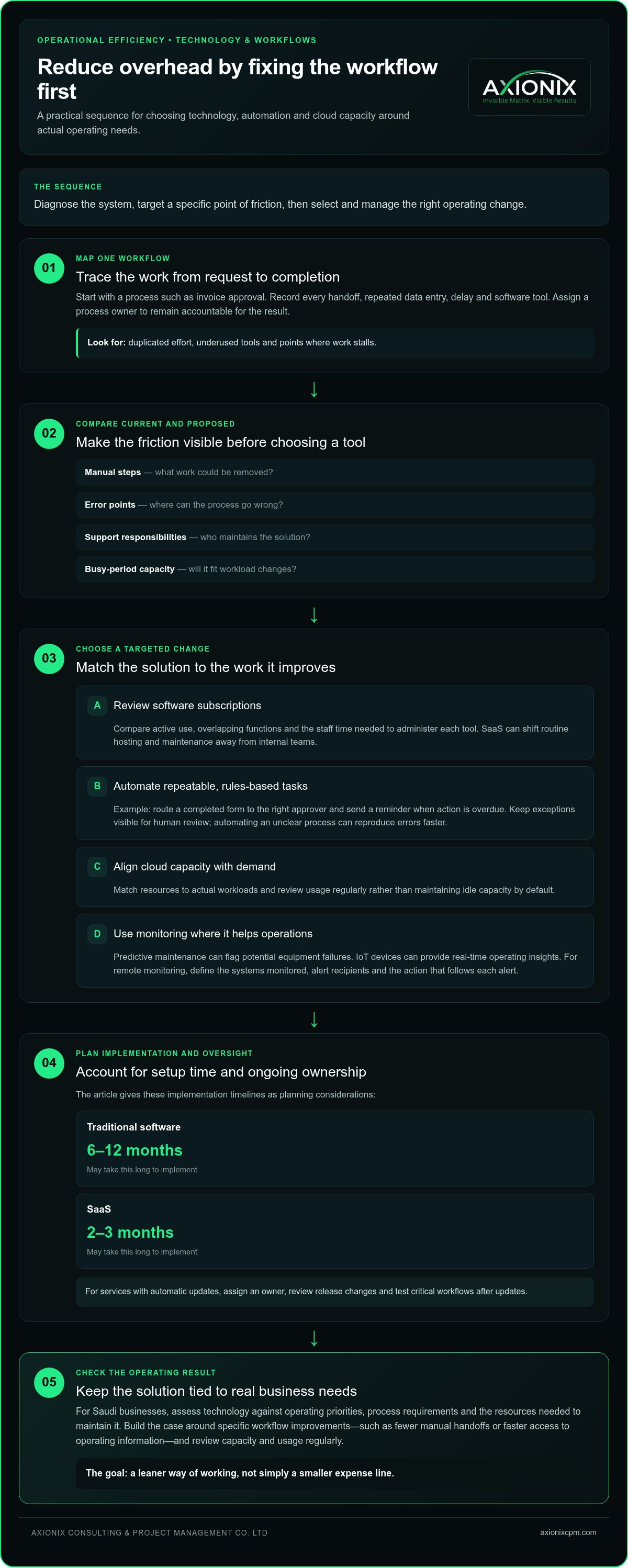
Technology reduces overhead when it removes duplicated effort, not when it adds another disconnected system. Start by mapping one workflow, such as invoice approval, from request to completion. Record each handoff, repeated data entry, delay, and software tool. Then identify whether automation or a cloud application can remove a specific point of friction. Keep a process owner accountable for the result.
SaaS can shift routine hosting and maintenance responsibilities away from internal teams. Where a service includes automatic updates, these can reduce manual deployment work and help keep the application maintained. They still need oversight: assign an owner, review release changes, and test critical workflows after updates. Compare subscriptions by active use, overlapping functions, and the staff time needed to administer each tool.
Automate repeatable, rules-based tasks first. For example, route a completed form to the right approver and trigger a reminder when action is overdue. Keep exceptions visible for human review; automating an unclear process can reproduce errors faster. For equipment-intensive businesses, predictive maintenance software can flag potential failures before breakdowns. IoT devices can provide real-time operating insights, helping teams respond to changing conditions.
Remote monitoring can help identify IT issues before they interrupt work. Define which systems need monitoring, who receives alerts, and what action follows each alert. That turns monitoring into an operational process rather than a stream of ignored notifications. Cloud capacity should follow demand: match resources to actual workloads and review usage regularly, rather than maintaining idle capacity by default.
For Saudi businesses, assess technology investments against operating priorities, process requirements, and the resources needed to maintain them. Build the business case around specific workflow improvements, such as fewer manual handoffs or faster access to operating information. This grounds the decision in your organisation’s needs rather than assumptions about external incentives.
Before adopting a tool, compare the current process with the proposed one. Track manual steps, error points, support responsibilities, and capacity needs during busy periods. Traditional software implementation may take 6-12 months, while SaaS implementation may take 2-3 months. Use those timelines as planning considerations, then select technology that fits the workflow and its maintenance needs.
3. Managed services and operational overhead
Operational overhead covers ongoing costs not directly tied to delivering a product or service. It can include the internal effort needed to maintain systems, support security, and manage routine administration. These costs persist even when demand changes. Managed services shift defined operational responsibilities to an external team, helping a business align internal capacity with its core work.
The value depends on scope, not the label. Define the function, expected outputs, decision rights, and escalation path before transferring work. For example, a business could assign routine IT infrastructure maintenance and security support externally while retaining internal ownership of access decisions and business priorities. Clear boundaries reduce duplicated effort and prevent critical tasks from falling between teams.
Operational capacity should fit the work a business needs done. When workloads change, review responsibilities, outputs, and the resources required, then adjust the operating model accordingly. This can help avoid carrying the same internal capacity through every demand cycle. Review outcomes regularly and revisit the arrangement when the business or its workload changes.
Routine work is a candidate for a different operating model when it consumes time without requiring constant internal judgment. Examples include recurring system maintenance, routine monitoring, and standard support tasks. Retail operations, for instance, can use round-the-clock monitoring and management of systems across physical stores and online platforms. For other businesses, proactive IT issue identification can help limit disruption and support system reliability.
A change in operating model does not remove accountability. Assign an internal owner to review performance, risks, and unresolved issues. Set a reporting rhythm that makes service quality and operational impact visible. Keep sensitive decisions and business-specific knowledge connected to internal leadership. If the function’s boundaries or required outcomes remain unclear, map the process before changing how it is managed.
For organisations assessing how external operational support could fit their structure, managed operational support can be considered as part of a broader operating-model review. The decision should turn on whether it releases internal capacity, preserves control where needed, and produces a coherent service boundary.
4. Outsourcing vs In-house for Reducing Overhead
Outsourcing and in-house operations distribute cost, control, and responsibility differently. An internal team provides direct oversight and preserves organisational knowledge, but requires ongoing management and capacity. Outsourcing assigns agreed work to an external provider, which can reduce internal workload but requires clear governance. Compare the operating requirements, not just the visible expense attached to each option.
Start with the function itself. For example, a company handling payroll internally may value close control over employee records and approvals. A business outsourcing a defined administrative process may instead prioritize freeing staff for customer work or production. In either case, map the work from request to completion. Include review, coordination, rework, and management effort in the comparison.
Demand is another deciding factor. If workload changes substantially across the year, a fixed internal structure can leave capacity underused during quieter periods. External support may offer a more adjustable arrangement when responsibilities and outputs are clearly defined. If the work depends on frequent judgment, confidential institutional knowledge, or rapid coordination with other teams, keeping ownership in-house may protect operating continuity.
- Retain internally: work requiring close strategic control, contextual judgment, or continuous coordination.
- Consider outsourcing: repeatable tasks with defined outputs and manageable handoffs.
- Compare fully: include supervision, training, process documentation, rework, and transition effort.
- Set accountability: name an internal owner, establish reporting, and define how exceptions are handled.
A hybrid structure can separate execution from oversight. For instance, an external team may perform routine processing while an internal manager approves exceptions and monitors results. This can preserve decision authority without requiring internal staff to perform every task. It only works when the boundary is explicit and both sides use the same workflow.
Choose the model that fits the work’s variability, knowledge requirements, and control needs. Start with a clearly bounded function, assess handoffs and service quality, then adjust the design before extending it. The aim is not to move every task outside the business or retain every task internally, but to place each responsibility where it fits best.
4. What steps can a small business take to audit and reduce overhead?
Begin with a complete cost picture, not a list of suspected waste. Calculate total operational costs by adding cost of goods sold to operating expenses. Separate fixed costs, such as rent and insurance, from variable costs, such as materials and direct labour. Mark semi-variable expenses, including maintenance and overtime, because they combine both patterns.
Next, review transactions and workflows together. Compare each recurring expense with the activity it supports. For example, check whether equipment is underused, whether two teams perform the same approval, or whether a process requires repeated data entry. An operational review can expose inefficient equipment, redundant steps, and underused resources. Protect safety and production while assessing possible changes.
Review software subscriptions individually. Match each active subscription to a team, task, and current usage. Identify tools with overlapping functions or no regular users, then decide whether to cancel or consolidate them. A subscription is not automatically wasteful because it is infrequently used; assess whether it supports a critical task before removing it.
Then examine workplace and utility patterns. A hybrid work arrangement may reduce office rent, commuting, electricity, and related overhead when the work supports it. Virtual office services, such as shared workspaces, mailing, internet access, and telecommunications, can offer an alternative to maintaining traditional office space. Compare service requirements with the space and resources actually used.
Finally, document each proposed change, its owner, and the process it affects. Review supplier contracts for overlapping services, and assess whether consolidating agreements could simplify administration. Analyse handoffs between departments, since unclear ownership can create repeated work and delays. Track operating results after changes, so reductions do not conceal new bottlenecks or weaken service delivery.
A disciplined audit links each expense to a process, an owner, and an operational need. If your review reveals disconnected costs and workflows, build a structured overhead audit to turn findings into coordinated decisions.
AXIONIX Consulting & Project Management: Operations as a Service (OaaS)
AXIONIX Consulting & Project Management helps organisations address overhead when disconnected operational responsibilities make internal capacity harder to align. Its Operations as a Service (OaaS) model connects operational capabilities through an integrated operating structure, giving businesses access to managed operational departments without building every function internally.
This approach can fit when an assessment reveals recurring work that needs clearer ownership, coordinated execution, or a more coherent operating model. AXIONIX Advisory provides business consulting and transformation support to help structure capabilities and processes. AXIONIX Studies offers feasibility studies to assess whether a proposed operational change is workable before it is adopted.
Start by defining the operational friction, the responsibilities involved, and the outcome your business needs. Book a discovery session with AXIONIX to discuss your operational priorities and explore an infrastructure assessment.
Make the Next Operating Decision Deliberate
Cost reduction is not the end state. The next step is to shape an operating model that can absorb change without adding unnecessary complexity. Use your assessment findings to distinguish work that needs internal ownership from work that can be integrated into a broader operating structure. That distinction creates a more deliberate path to reduce operational overhead while preserving the capabilities your business depends on.
AXIONIX Consulting & Project Management Co. LTD offers Operations as a Service (OaaS), Business Consulting, and Transformation. These offerings can support organisations assessing how responsibilities, processes, and operating capabilities should fit together. Start by defining the operational friction and the business outcome you want to address.
Contact AXIONIX Consulting & Project Management Co. LTD to discuss your next operating decision. Build the structure that lets your business move forward with greater clarity.
Frequently Asked Questions
What does reducing operational overhead mean?
It means redesigning the support work and resources around delivery so they consume less effort without weakening the customer outcome. For example, a small distributor might simplify how delivery exceptions are approved, rather than reducing customer support. The key test is whether a change removes avoidable work while preserving service quality, accountability, and the capacity to meet demand.
Which strategies reduce operational overhead for a business?
A business can reduce operational overhead by targeting the source of recurring friction, then testing changes against service needs. A Saudi retailer, for example, could assign clear ownership for stock discrepancies and track how often they require escalation. Prioritise changes by operational impact, implementation effort, and risk. A focused pilot helps reveal unintended consequences before the new approach becomes standard.
How can process automation reduce operating costs?
Automation reduces costs by completing repeatable work with fewer manual touches and less avoidable rework. For example, a system can compare goods received with purchase orders and flag mismatches for staff review. Employees can then focus on exceptions instead of checking every matching record. Define the rules, exception owner, and review process first; automation works best when the underlying task is consistent.