Business Infrastructure Services: Costs and Savings Explained

Growth stalls when its operating fabric cannot carry the load. Business infrastructure services coordinate the physical systems, people, processes, and operational tools that keep an organization functioning and support manageable, profitable growth. In practice, that foundation can include hardware, software, networks, data storage, system monitoring, maintenance, and employee IT support.
Businesses often treat these elements as separate purchases or isolated tasks. But weak connections create friction: delayed work, duplicated effort, and capacity that cannot adapt as operations change. The question is not simply what equipment a business owns, but how its infrastructure works together as the business expands.
This article explains the components of business infrastructure, how managed services support daily operations, and how maintenance, capacity, and operating design affect costs. You’ll learn how support can reduce avoidable disruption, which decisions shape infrastructure costs, and why the right model depends on how the organization works. The goal is to see infrastructure as an operating system for growth, not a technology checklist.
Key Takeaways
- Assess infrastructure as a connected operating system, not a collection of isolated assets, to identify where capacity and coordination matter most.
- Managed support can combine expert assistance with routine maintenance, helping teams address technical friction and keep essential systems functioning.
- Infrastructure costs depend on the resources maintained, the support model, and how capacity changes with business needs; savings come from reducing inefficiency and avoidable disruption.
- When operational complexity outgrows internal coordination, Operations as a Service can provide a structured way to connect capabilities without building every function in-house.
Table of Contents
What are the main benefits of managed infrastructure services?
Managed support combines specialist oversight with ongoing maintenance across systems, users, and devices. Its value depends on the services included, response arrangements, and operational priorities.
Expert Support and Regular Maintenance
Specialist support applies technical knowledge to maintain systems and resolve operational issues. Regular reviews, updates, and patches can identify emerging problems before they interrupt work. For example, monitoring server performance may reveal declining capacity before employees lose access to shared files. A service desk gives employees a clear way to report password, software, hardware, and system-access issues.
Outsourced Infrastructure Support
External support assigns selected technology tasks to a specialist rather than relying only on internal IT. This can help when a team lacks the capacity or expertise to integrate new technology. A business might assign network monitoring externally while retaining control of priorities. Clear responsibility for access, escalation, and data handling helps manage reliance on external support.
Infrastructure Support for Business Growth
Growth-oriented support adjusts technology capacity as workloads, locations, and user needs change. A company may need additional devices, network capacity, or server resources as operations expand. Monitoring helps align those changes with business requirements. This matters in Saudi Arabia, where digital transformation is part of Vision 2030, while infrastructure still needs to fit each organization’s operating model.
Compared with in-house IT in Saudi Arabia, managed support can provide specialist expertise and handle selected tasks, while internal teams retain direct control. Applicable obligations depend on the business activity, data, and systems involved. Data protection and cybersecurity considerations inform access, storage, and security controls.
Support may cover helpdesk troubleshooting, network and server management, hardware and software maintenance, backups, and security monitoring. Choose a model by assessing current systems, business priorities, user needs, and service responsibilities. Setup involves mapping requirements, selecting components, connecting systems, and planning maintenance and recovery. Common risks include unclear accountability, access issues, and reliance on external support.
Business infrastructure definition and components
Business infrastructure combines physical systems, people, processes, and operational tools to support manageable, profitable growth. For a Saudi business, that foundation could connect an office network, employee devices, business data, and the procedures needed to keep work moving. The key components work as an integrated system, not isolated purchases.
Physical infrastructure carries and processes information. Fiber-optic cables transmit data over long distances, while copper cables suit shorter connections. Switches connect devices and manage network traffic; routers direct information to its destination. Servers store data, run programs, and respond to requests. A data center may house systems, while cloud resources provide computing capacity online.
Logical components determine how physical assets communicate. Network protocols establish shared rules between devices, while network software helps teams monitor performance and locate faults. Firewalls, encryption, and passwords help protect data. For example, a router moves a request between networks, while protocols allow connected systems to interpret that traffic.
Infrastructure also includes data storage, software, and recovery arrangements. Backups can help restore business data after a cyberattack, natural disaster, or system failure. Disaster recovery links those copies to a practical restoration process. A hybrid environment combines cloud services with on-premise data centers, allowing an organization to place workloads according to operational needs.
For a Saudi organization, connectivity should link users, devices, and locations to the systems they need. Power provision should support equipment in operation, while backup and recovery arrangements address data loss and service interruption. Design depends on workloads, locations, and continuity priorities, not a universal equipment list.
To assess the fit, map business processes to the systems and connections they rely on. Identify where data travels, where it is stored, and how teams would restore access after disruption. A structured business infrastructure assessment can help align those components with operational objectives.
Cost savings and maintenance costs
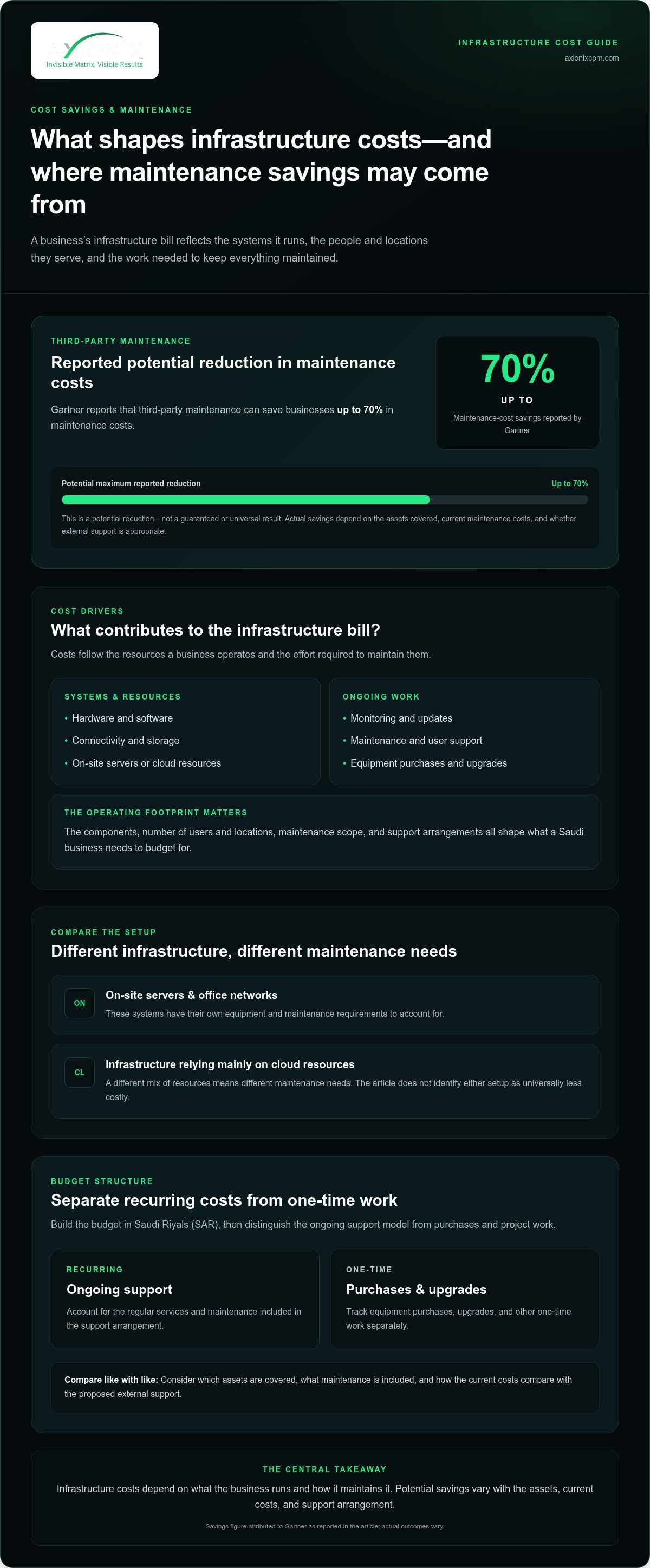
Infrastructure costs reflect the systems a business operates and the work required to maintain them. Hardware, software, connectivity, storage, monitoring, updates, and user support all contribute. A Saudi business running on-site servers and office networks has different maintenance needs from one relying mainly on cloud resources.
For businesses in Saudi Arabia, costs depend on the components, users, locations, maintenance scope, and support arrangements required. Build the budget in Saudi Riyals (SAR), then separate recurring support from equipment purchases, upgrades, and other one-time work. This makes operating models easier to compare.
Gartner reports that third-party maintenance can save businesses up to 70% in maintenance costs. This is a potential reduction, not a universal result. Savings depend on the assets covered, current maintenance costs, and whether external support replaces or supplements internal work.
Model total operating costs, not just the service fee. Include hardware upkeep, software updates, employee support, monitoring, backups, and the internal time needed to coordinate work. For example, lower maintenance costs may be offset if employees lose productive time to unresolved access problems or recurring system faults.
Threats and failures also affect the financial picture. Proactive maintenance can address issues before they cause costly downtime. Backup and recovery planning can help restore data after system failure or cyberattack. Compare preventive maintenance costs with the operational impact of interruption, including delayed work and disrupted customer service.
- Map the technologies and assets that need maintenance.
- Separate recurring support from upgrades and one-time work.
- Compare internal effort, external support, and downtime exposure.
These steps reveal where the operating model carries avoidable costs. A sound comparison weighs support scope and business impact rather than relying on a headline percentage.
The brochure reports an award for saving 429 tons through a Zurich facilities partnership. IT maintenance helps prevent problems and downtime; hardware and software upkeep may cover updates, patches, hardware installation, configuration, and licensing.
Definition of business infrastructure
Business infrastructure comprises the physical systems, people, processes, and operational tools that support sustainable growth. It is more than a catalogue of hardware. Processing an order, for example, depends on staff, approval steps, information, and tools working together. Infrastructure includes the structures that make work repeatable, coordinated, and able to expand.
Consider a company handling customer requests. Employees need a clear process for receiving, assigning, and resolving each request. The process depends on access to relevant information and tools for recording decisions. If one connection fails, work can stall even when other equipment remains operational. Infrastructure is the relationship between resources and the work they enable.
This distinction changes how leaders diagnose problems. Replacing hardware will not fix delays caused by unclear responsibilities or disconnected workflows. A team, for instance, may have functioning devices but no consistent handoff between sales and finance. A useful assessment traces a task from start to finish, identifying the people, systems, and decisions each step requires.
Infrastructure also includes continuity: how an organization sustains essential work during a disruption. A disaster, system failure, or unavailable key employee can expose dependencies hidden by routine operations. Mapping those dependencies helps leaders identify which processes need alternatives, which records need recovery arrangements, and where a single point of failure could become costly.
Growth tests whether the operating structure can absorb change. Opening a branch, adding a service, or increasing transaction volume affects more than equipment. It can change approvals, reporting, employee responsibilities, and information flows. Leaders should assess whether each new activity fits existing processes or creates a bottleneck that calls for a redesigned operating model.
Use a practical test: choose one critical business outcome, trace its steps, and record the people, tools, information, and handoffs involved. Then identify the dependencies that could interrupt delivery. This reveals infrastructure as an operating architecture, not an inventory. To clarify how those elements fit together, map your operating model.
AXIONIX Consulting & Project Management: Operations as a Service (OaaS)
AXIONIX Consulting & Project Management helps organizations address fragmented operations through Operations as a Service (OaaS), connecting operational capabilities in a synchronized fabric. This approach is relevant when internal processes, responsibilities, and resources no longer align with business needs, or when growth reveals gaps between departments.
Business Consulting can clarify operational challenges, while Transformation can help reshape how capabilities work together. Feasibility Studies support decisions about proposed changes before resources are committed. The focus is structural: identify friction, assess the operating model, and determine how capabilities can better support execution.
For leaders facing disconnected functions or rising coordination demands, this provides a route to examine the operating system behind the work. To discuss your organization’s needs, contact AXIONIX Consulting & Project Management or visit axionixcpm.com.
Build the Operating Model for What Comes Next
Infrastructure decisions shape how an organization responds to change. Start by identifying where operating responsibilities, resources, and business priorities no longer align. This diagnosis gives leaders a clearer basis for deciding what to retain, redesign, or manage differently.
Business infrastructure services should support the operating model, not add another disconnected layer. AXIONIX Consulting & Project Management Co. LTD offers Operations as a Service (OaaS), Business Consulting, and Transformation to help organizations address operational structure and change. These offerings are relevant when growth or complexity reveals gaps between capabilities and execution.
Start with the operational challenge that most constrains progress. A focused discussion can help clarify the decision ahead and the structure needed to move forward. Contact AXIONIX Consulting & Project Management Co. LTD to discuss your organization’s priorities and take the next step with greater clarity.
Frequently Asked Questions
Business Infrastructure Support Services: What Do They Look Like?
Effective support means defined channels, clear responsibilities, and visible records of resolution. For example, when an employee reports a shared-system access failure, the issue should be recorded, assigned an owner, and tracked through resolution. Teams can then review recurring incidents to identify common causes. This makes support visible to leaders: they can see what is reported, who handles it, and where unresolved issues accumulate.
Who is it for?
Infrastructure support suits organizations that rely on connected teams, systems, or locations, especially during expansion or process change. A growing retailer, for example, may need consistent coordination between sales, inventory, finance, and customer service. Company size alone is not decisive. The signal is whether gaps in ownership or coordination repeatedly slow essential work. Define the pressure point before choosing a support model.
What are business infrastructure services?
Business infrastructure services are the activities that help an organization plan, coordinate, and sustain the systems and operating capabilities its work relies on. Infrastructure is the underlying structure; services are the ongoing work applied to it. An organization, for example, may have network equipment but still need clear responsibility for monitoring, maintenance, user support, and continuity planning. Scope should follow business needs.
How do businesses choose infrastructure services in Saudi Arabia?
Assess current systems, business priorities, user needs, and service responsibilities. Compare support scope and business impact, including internal effort and exposure to downtime, keeping local compliance and operational requirements in mind.