Business Operations Consulting and Its Role in Value-Chain Improvement

Operational performance is determined by how work moves across the value chain, not by strategy decks alone. Business operations consulting helps organizations identify friction across processes, structures, and management systems, then redesign how work is delivered. The focus is practical: connect decisions, people, and workflows so value moves more reliably from supply and production to customer delivery.
That distinction matters. Strategy sets direction; operations consulting translates it into operating models and process improvements. Technology and people may be part of the solution, but the central task is aligning how work gets done with what the business needs to deliver.
This article explains what operations consultants do, how the work differs from strategy, IT, and HR consulting, and how operational changes can improve value chains as demand shifts. It also covers common triggers, from fragmented handoffs to pressure to improve efficiency, so you can identify where consulting can lead to structural improvements rather than another set of recommendations.
Key Takeaways
- Trace operational friction across processes, structures, and management systems to identify where work slows or loses value.
- Distinguish operational improvement from strategy, IT, and HR work by focusing on how the business delivers its products and services.
- Connect market pressures such as cost reduction and transformation to specific changes in operating performance.
- Map the value chain from supply and production through delivery to reveal where better coordination can improve flow.
Table of Contents
Wat does an operations consultant do?
An operations consultant examines how work moves through an organization, then redesigns processes, structures, and management systems. Business operations consulting might involve mapping a finance approval, identifying repeated handoffs, and testing a more efficient workflow. The goal is an operating model that turns strategic priorities into consistent delivery.
Some firms specialize in operational work; others offer operations consulting within a broader practice. Both may help standardize shared services, such as payroll or procurement, around common processes and controls. The firm’s structure shapes its expertise, but leaders still need clear accountability, measurable outcomes, and an approach that supports implementation.
Operating and service delivery models define where work happens, who owns it, and how services reach users. For example, an organization might consolidate routine finance processing into a shared-service center while keeping approvals with local teams. Offshoring and global business services add decisions about location, consistent processes, governance, and coordination across operating units.
Finance operations can include accounts payable, reporting workflows, planning, and CFO services. A consultant might map an invoice from receipt to payment, then remove duplicate reviews. Customer service transformation follows a similar approach: trace the path from first contact to resolution, clarify escalation ownership, and align service processes with customer needs.
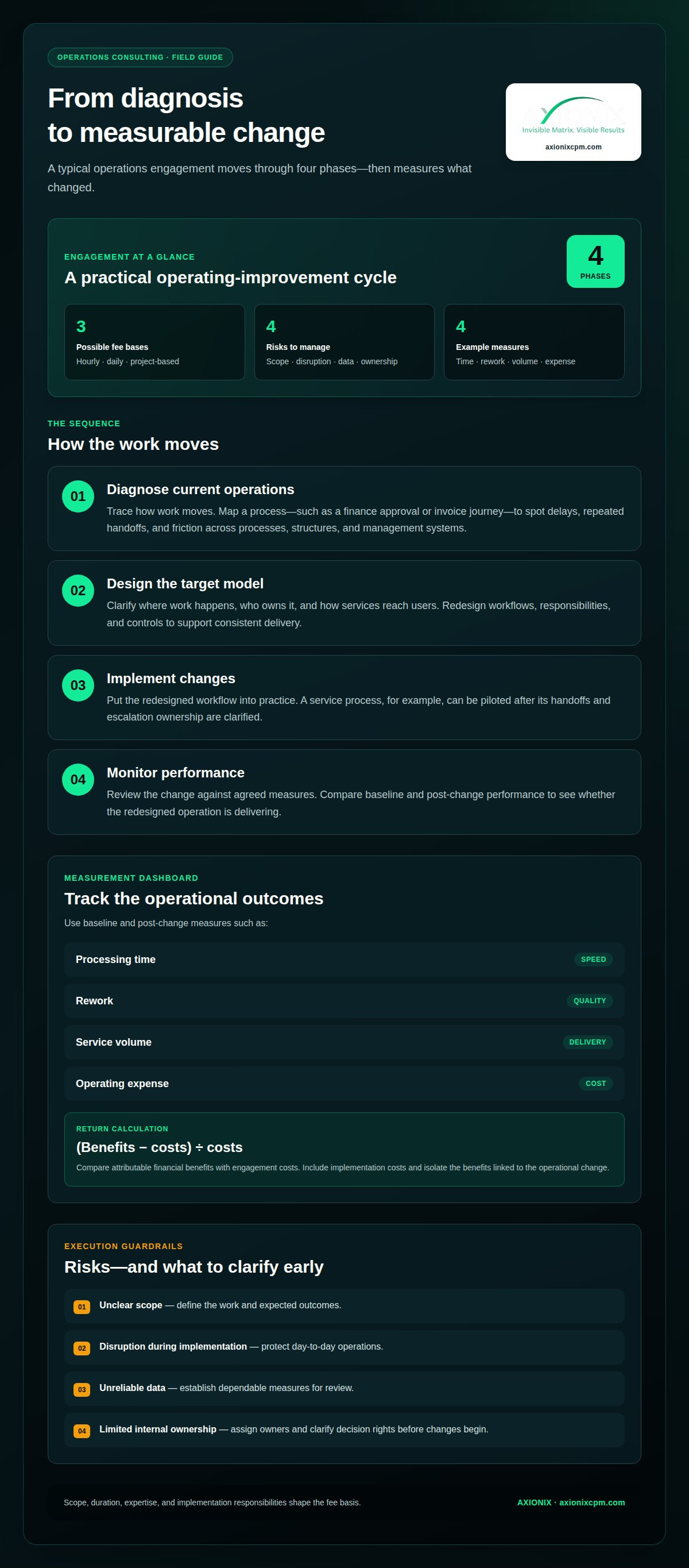
How do operations consultants in Saudi Arabia charge: hourly, daily, or project fees? Engagements may use hourly, daily, or project-based fees. The price depends on scope, duration, expertise, and implementation responsibilities, and is provided after a quote request.
A typical engagement moves through four steps: diagnose current operations, design the target model, implement changes, and monitor performance. A process map, for example, can reveal delays before a redesigned service workflow is piloted and reviewed against agreed measures.
Risks include unclear scope, disruption during implementation, unreliable data, and limited internal ownership. A new finance workflow, for example, can stall when approval responsibilities are ambiguous. Define decision rights, protect day-to-day operations, and assign internal owners before changes begin.
Operations consulting compared with strategy, IT, and HR consulting
Strategy defines where a business intends to compete; operations consulting reshapes how it delivers. A procurement strategy might prioritize supplier resilience, while operational work redesigns approval flows, supplier onboarding, and purchasing controls. Operations strategy connects these choices to performance improvement, translating demand priorities into processes, responsibilities, and measures.
Management consulting has a broader remit. The United Nations Statistics Division defines general management consulting as advice, guidance, and operational assistance concerning business policy and strategy, as well as an organization’s overall planning, structuring, and control. Operations consulting focuses that work on the systems that execute tasks. A firm may offer both, but the right fit depends on whether the main challenge is strategic direction or execution.
IT consulting addresses technology architecture, systems, and implementation. Operations consulting examines how those tools fit real workflows, often in close cooperation with digital and IT consultants. A procurement platform can automate approvals, for example, but process design must first clarify decision rights, exceptions, and ownership. Strategic technology partnerships align system choices with operating needs instead of treating software deployment as the end goal.
HR consulting focuses on workforce policies, organizational design, and people capabilities. Operations work examines how roles interact with processes. A service redesign, for example, may require clearer handoffs between customer support and finance, along with role-specific training. The disciplines overlap, but their primary levers differ.
For Saudi engagements, fee structures may be hourly, daily, or project-based. The right basis depends on scope, duration, specialist input, deliverables, and implementation responsibilities. Compare these factors alongside a clearly defined scope of work.
Measure return by comparing attributable financial benefits with engagement costs: (benefits minus costs) divided by costs. Track baseline and post-change measures such as processing time, rework, service volume, and operating expense. For a procurement redesign, isolate savings from improved purchasing controls and include implementation costs.
Where performance gaps cross functions, operational performance improvement can help connect process changes to measurable outcomes.
Operations consulting market size and demand drivers
Demand reflects pressure to reduce costs, improve performance, and transform functions such as sales and finance. Market growth can also indicate where organizations are directing operational investment.
Demand for Operations Consulting
Demand for operations consulting is driven by the need to make business functions perform more effectively. Cost-cutting, downsizing, and transformation can expose friction in finance, sales, marketing, and other functions. For organizations in Saudi Arabia, this makes operational improvement relevant as market conditions and business priorities shift. The practical test is whether a proposed change addresses a specific constraint, such as slow sales handoffs or duplicated reporting.
Operations consulting grew at an average compound annual growth rate of 5% over the past six years. It represents nearly 30% of the global consulting market. These figures indicate a substantial field, but they don't establish the return on an individual investment. That depends on the operating problem, implementation discipline, and whether leaders track outcomes after the redesign.
Regional coverage varies by market and ranking scope. Middle East Operations assessments covered more than 500 consulting firms; the latest Top Consulting Firms in the Middle East assessment covered more than 1,400. These counts describe assessment coverage, not the number of firms active in Saudi Arabia.
Regulations and Industry Requirements
In Saudi Arabia, operational requirements depend on the organization’s sector and the activities being redesigned. A change affecting finance controls, customer information, or workforce processes should account for the requirements relevant to those activities. Before implementation, map process owners, data flows, control points, and applicable obligations. This helps executives assess how a proposed operating model fits the business context without treating consulting as a substitute for compliance expertise.
To select an operations consultant in Saudi Arabia, define the intended outcome and affected functions first. Assess relevant implementation experience, how the engagement will establish a baseline, and who will own changes internally. For example, a sales redesign should set out how lead handoffs and conversion performance will be evaluated.
Sales and marketing operations connect demand signals to execution. A consultant might examine how a digital platform routes leads, aligns campaign data, and supports sales follow-up. Identify a bottleneck, redesign the workflow, then measure its effect on conversion or response time. Let process needs guide technology investment, not the other way around.
Consultant roles in value-chain improvement
Value-chain improvement depends on how connected activities work together, not on individual departments optimizing in isolation. An operations consultant traces the path from supplier inputs to customer delivery, identifying delays at handoffs and mismatches between demand and capacity. A production schedule, for example, may look efficient internally but fail when inventory records lag behind actual stock.
In supply chain work, consultants assess demand planning, forecasting, manufacturing operations, logistics, warehousing, and inventory management. They can map how a forecast becomes a purchase order, moves through production, and reaches a customer. This reveals whether a bottleneck lies in supplier coordination, warehouse flow, or delivery planning. Effective improvements address the constraint across the network instead of shifting it to another team.
A sound diagnosis connects proposed changes to operating measures. A consultant may compare forecast accuracy, inventory availability, order cycle time, and delivery reliability before recommending a redesign. If late demand signals repeatedly cause stockouts, the response might combine clearer data ownership, adjusted replenishment rules, and closer coordination between sales and procurement. The aim is efficiency across the chain, not a local gain that creates extra work elsewhere.
Implementation turns the future-state design into working routines. Process owners need defined decision rights, practical training, and a way to identify exceptions. A new inventory-planning process, for example, should specify who resolves mismatches between forecast demand and warehouse records. These capabilities help internal teams sustain changes after the initial redesign.
Consultants should also test whether each proposed change strengthens the full value chain. A logistics improvement that reduces handling effort but delays customer delivery is not an improvement. Map dependencies, assess effects on adjacent activities, and track results against the original baseline. This keeps performance improvement tied to customer value and operational reality.
Executives seeking to strengthen cross-functional execution can develop value-chain capabilities around clear ownership, coordinated processes, and measurable outcomes.
AXIONIX Consulting & Project Management: Operations as a Service (OaaS)
AXIONIX Consulting & Project Management helps organizations address operational gaps through Operations as a Service (OaaS), Business Consulting, and Transformation. Its integrated operational infrastructure connects capabilities through a synchronized operating fabric, giving businesses access to enterprise capability without enterprise overhead.
This model fits when process improvements require sustained operational capacity or growth exposes gaps between teams, workflows, and management systems. When an initiative needs evaluation before implementation, Feasibility Studies can help assess its direction. Start with the operating constraint: where work stalls, which capability is missing, and what the organization needs to deliver.
To discuss operational needs with AXIONIX Consulting & Project Management, visit axionixcpm.com.
Build the Operating Capacity for What Comes Next
Growth tests the connections between decisions, teams, and delivery. Identify the constraint that most limits performance, then determine whether it calls for process redesign, added capability, or a different operating structure. Business operations consulting is most useful when diagnosis leads to ownership and implementation, not another recommendation detached from daily work.
AXIONIX Consulting & Project Management Co. LTD offers Operations as a Service (OaaS), Business Consulting, and Transformation. These offerings can support organizations facing operational complexity that exceeds their current structure or seeking to align improvement work with broader change. Before shaping the work, define the outcome that matters, the teams affected, and how progress will be assessed.
For a measured conversation about your operational priorities, contact AXIONIX Consulting & Project Management Co. LTD. A clear view of the constraint is a strong foundation for building what comes next.
Frequently Asked Questions
What does business operations consulting include?
Business operations consulting involves diagnosing how work is structured, redesigning processes and decision rights, and supporting implementation and measurement. Its scope can cross functions rather than stop at one department. During a product launch, for example, a consultant might align demand planning, procurement approvals, production readiness, and customer support around shared milestones, clear ownership, and an escalation path.
What problems can an operations consultant help a business solve?
An operations consultant can help resolve recurring gaps between customer commitments and delivery capacity. If sales promises repeatedly exceed fulfilment capability, the consultant can trace how forecasts, commercial approvals, and inventory signals interact. This helps distinguish inaccurate demand assumptions from slow authorization or capacity decisions. Leaders can then prioritize changes by customer impact and dependencies, assign owners, and monitor service reliability after implementation.
How do I choose the right business operations consultant?
Define the intended outcome and affected functions first. Then assess relevant implementation experience, how the consultant will establish a baseline, and who will own the changes internally to ensure long-term success with partners like AXIONIX Consulting & Project Management Co. LTD.