Outsourced Operations vs In-House: Compare Costs and Expertise

Outsourcing shifts operational work to an external provider; in-house operations keep the work under your own management. In the outsourced operations vs. in-house decision, neither model is automatically cheaper or more capable. The right structure depends on the work’s strategic importance, the expertise required, the costs your organization must carry, and its need for control and data protection.
An in-house team can offer closer oversight, while an external provider may bring specialist capabilities without requiring you to develop them internally. But salaries alone do not show the full cost, and delegating work does not remove the need for governance. A useful outsourced operations versus in-house assessment weighs these trade-offs against each function’s role in the business.
This comparison explains what outsourcing means and how the two models differ in cost, expertise, contractual exposure, and data security. It also considers when a hybrid structure may reduce friction. The outsourced operations versus in-house choice becomes clearer when you assess each activity against its operational requirements.
Key Takeaways
- Compare the full operating cost, including recruitment, training, management, and infrastructure, rather than relying on salary or provider fees alone.
- Identify where specialist expertise is difficult to develop internally, then weigh the value of external capability against the importance of retaining knowledge in-house.
- Reduce contract and data-security exposure by defining scope, confidentiality, performance measures, and oversight responsibilities before work begins.
- Use a hybrid model when different activities require different levels of control, flexibility, and specialist input; assess each function on its own merits.
Table of Contents
What is the difference between in-house and outsourced?
In-house work is performed by employees managed within your organization; outsourced work is assigned to an external vendor under agreed terms. For Saudi businesses, compare who directs the work, controls sensitive information, develops staff capability, and remains accountable for each function. The decision concerns operating structure, not simply headcount.
In Saudi Arabia, consider the requirements that apply to the employing entity and the function being delivered. Clarify responsibilities for employee management, payroll processes, information access, and service oversight before assigning work externally. These responsibilities should be reflected in internal procedures and the vendor agreement.
Choose and onboard an external provider through a defined sequence: describe the function and expected outputs; assess the provider’s capability, security practices, and proposed terms; then set access permissions, reporting channels, and transition responsibilities. For example, define payroll processing measures and approval ownership before transferring that workflow.
Developing in-house talent can build institutional knowledge and employee loyalty when training supports clear responsibilities and progression. An external provider may offer specialist capability without requiring the business to develop every skill internally. Before deciding, identify which expertise must remain embedded in the organization and which functions can be delivered externally to an agreed standard.
Payroll automation and employee self-service can streamline routine requests, such as accessing payslips or submitting leave. Assign owners for data changes, approvals, and escalations. Turnover also affects training investment: repeated onboarding uses internal capacity, while an external arrangement calls for documented processes and continuity planning.
In-house teams give managers direct oversight, but internal control still requires clear ownership and confidentiality practices. For either model, map who supervises the work, manages employee records, and handles sensitive information under applicable Saudi requirements.
| Option | Control | Talent development | Operational focus |
|---|---|---|---|
| In-house | Direct team oversight | Builds internal knowledge | Requires internal management capacity |
| Outsourced | Governed through vendor terms | Accesses external capability | Transfers defined work externally |
Choose in-house operations for work that requires embedded knowledge and direct control. Choose an external model when its capabilities better fit the operating need.
Outsourcing cost savings and access to specialized expertise
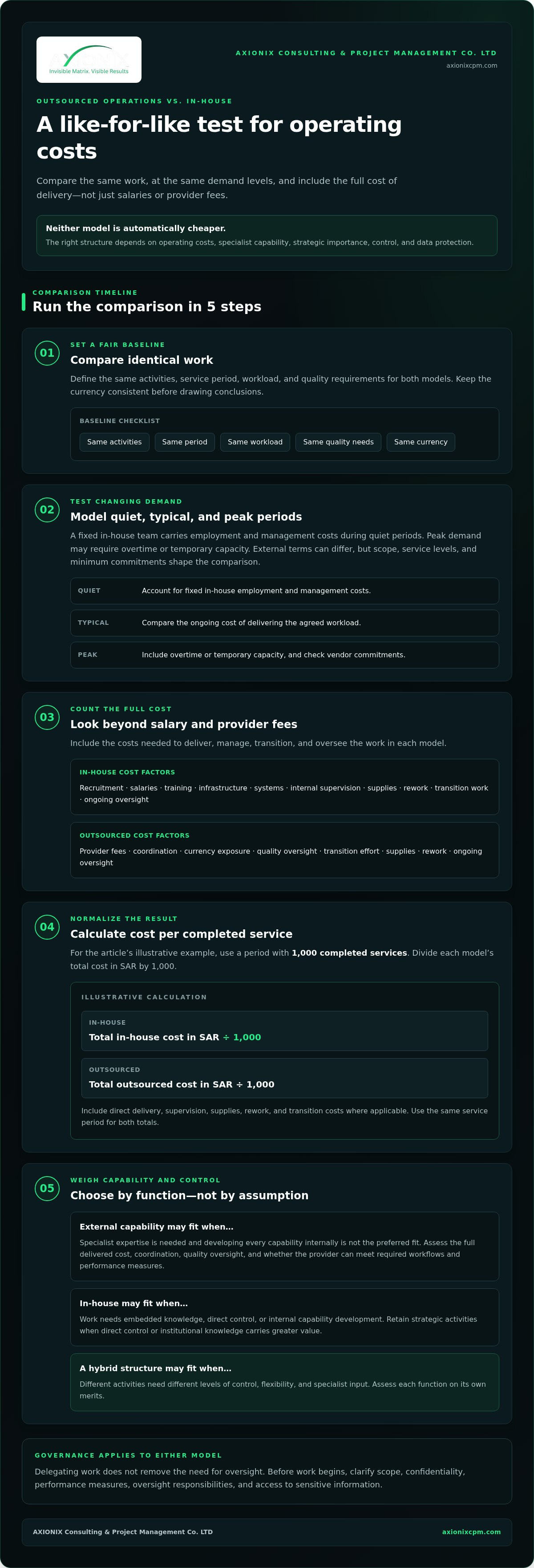
An external provider can offer specialist expertise without requiring you to develop every capability internally. It may also shift some recruitment, training, and facility demands to the provider. Savings are not automatic. Compare the full cost of each model, including internal supervision, systems, transition work, and ongoing oversight. Price the same activities over the same period and in the same currency before drawing conclusions.
Payroll data can strengthen workforce and cost forecasts. Use historical payroll, overtime, absence, and workload patterns to map staffing needs against demand. Separate fixed commitments from costs that vary with hours or output. For example, recurring overtime during seasonal peaks may indicate a capacity gap, while stable workload and high turnover may point to training or process inefficiencies. Keep access to sensitive payroll data controlled.
Model quiet, typical, and peak periods separately. A fixed in-house team carries employment and management costs during quiet periods, while peak demand may require overtime or temporary capacity. External terms may offer a different cost structure, but scope, service levels, and minimum commitments affect the comparison. Test each scenario against the same workload and quality requirements.
For an illustrative cost-per-service calculation, take a period containing 1,000 completed services. Divide the total in-house cost in SAR by 1,000, then divide the outsourced total for the same period by 1,000. Include direct delivery, supervision, supplies, rework, and transition costs where applicable. The resulting figures reveal whether one model costs less per completed service.
Working with a provider in a nearby market may offer access to expertise, but lower wages alone do not establish savings. Compare the full delivered cost, including coordination, currency exposure, quality oversight, and transition effort. Then assess whether the provider can meet required workflows and performance measures. Keep strategic activities internal when direct control or embedded knowledge carries greater value.
For organizations assessing an integrated operating model, Operations as a Service can be considered as a way to structure operational capacity around defined needs.
Risks of third-party contracts and data security
Outsourcing changes who performs the work, not the organization’s need for oversight. An external provider may use different security standards, processes, or access controls. Before transferring payroll or customer records, map each data flow, identify who can access sensitive information, and define how access ends when the work stops. In-house operations give managers direct control over employees, but hiring internally does not remove confidentiality or quality risks.
An agreement with an external provider should define the scope of work, tasks, deadlines, payment terms, service period, performance measures, and confidentiality obligations. Include a non-disclosure agreement, access and data-handling expectations, reporting arrangements, and a process for resolving service failures. Service-level agreements should specify measurable indicators, such as processing accuracy or response time, and explain how results are reviewed and corrective actions assigned.
Assess a provider’s reputation, track record, and security practices before sharing information. Compare its controls with your own standards, then restrict access to the data and systems required for assigned tasks. For example, a payroll provider may need employee pay data but not access to unrelated customer records. Keep responsibility for approving access and reviewing exceptions inside your organization.
An in-house team supports closer day-to-day supervision. Managers can observe workflow changes, review records, and correct errors within internal procedures. That control still depends on clear ownership. Assign a process owner, document confidentiality rules, and separate approval from execution for sensitive transactions. These controls apply whether staff developed their expertise internally or joined through hiring.
Quality oversight needs defined measures in either model. Set baseline performance indicators, review results on an agreed schedule, and record corrective actions with an owner and due date. Use communication and monitoring channels to track external work, and apply the same discipline to internal operations. A performance review should connect each variance to a cause, such as unclear instructions, access errors, or incomplete training.
For Saudi operations, align contract controls with the organization’s applicable requirements and internal policies. The practical test is clear: retain direct oversight of data access, quality measures, and accountability, even when a vendor performs the work.
In-house and outsourced operations: pros and cons
In-house teams offer direct control; outsourcing can add flexibility and specialist capacity. In South Africa, commonly outsourced examples include payroll, web services, legal services, public relations, and online security.
In-House Operations
An in-house model places employees, workflows, and infrastructure under internal management. It suits activities that depend on embedded knowledge, frequent coordination, or close control of sensitive decisions. Managers can adjust priorities directly and retain expertise as staff develop. The trade-off is financial and operational responsibility for hiring, training, supervision, systems, and capacity, including periods when demand falls.
Commonly Outsourced Operations
An external model assigns defined work to a provider under agreed terms. Payroll, web services, public relations, and online security are examples of functions companies often assign externally. This model can provide specialist capability and let internal teams focus on core activities. Trade-offs include less direct control over daily execution and the need to coordinate scope, quality, and information access.
The pros and cons depend on the work, not the label. A business may keep strategic decisions and customer-sensitive processes internal while assigning repeatable support activities externally. This division can preserve institutional knowledge without requiring every specialist function to sit inside the organization. But split ownership can create friction if internal and external teams use different workflows or performance measures.
Use a hybrid structure when functions have different requirements. Set an internal owner for each outsourced activity, define how work enters and leaves the process, and align reporting across both teams. For choosing a model, compare strategic importance, demand variability, required expertise, control needs, and total operating burden. Assess your operating model against those criteria before changing ownership.
AXIONIX Consulting & Project Management: Operations as a Service (OaaS)
AXIONIX Consulting & Project Management provides Operations as a Service (OaaS) for organizations assessing how operational work should be structured. It can be relevant when internal teams face capacity constraints, when specialist functions need a clearer operating design, or when leaders are evaluating a shift between internal and external delivery.
AXIONIX Advisory provides business consulting, transformation, and strategic advisory to help frame operating-model decisions around organizational priorities. AXIONIX Studies offers feasibility studies to support assessment of a proposed change before implementation. The focus is structural: clarify the operational need, assess the appropriate model, and align capabilities with business objectives.
For Saudi organizations comparing internal ownership with outsourced delivery, the next step is to define the function, its requirements, and the desired operating arrangement. Contact AXIONIX Consulting & Project Management or visit axionixcpm.com to discuss your operational priorities.
Build an Operating Model That Can Evolve
Treat your operating model as an asset that must evolve with business priorities. Assign clear ownership for each function, then set review triggers such as changes in demand, strategic direction, or internal capability. This helps prevent temporary arrangements from hardening into permanent friction.
The outsourced operations vs. in-house decision is not a one-time verdict. Revisit it as your organization’s priorities and capabilities change. A useful review asks whether each activity still belongs in its current operating structure and whether that structure supports the business’s direction.
AXIONIX Consulting & Project Management Co. LTD offers Operations as a Service (OaaS), Business Consulting, and Transformation to support operational design and change. Consider how an outsourced operations versus in-house model fits your next stage of growth, then book a discovery session with AXIONIX.
Discuss your operating model with AXIONIX Consulting & Project Management Co. LTD and identify a practical next step. A deliberate structure gives your organization a stronger foundation for what comes next.
Frequently Asked Questions
What is outsourcing?
Outsourcing means assigning defined business work to an external organization rather than having your own employees perform it. For example, a company might contract a provider to process routine customer enquiries while internal staff handle complex complaints. The business remains responsible for deciding what work moves, setting expectations, and assessing whether the arrangement supports its operating priorities.
At What Call Volume Does Outsourcing Become Cheaper Than Building In-House?
There is no universal call-volume threshold because costs depend on staffing, facilities, supervision, and workload patterns. A 2026 US estimate places the point where outsourcing typically becomes cheaper at a need for more than 10 to 15 full-time agents. Treat that as a US call-center reference, not a Saudi benchmark. For a Saudi operation, model actual demand and local costs in SAR.
What Is In-House Production?
In-house production means a business uses its own employees, equipment, and processes to create a product or deliver a service. A manufacturer, for instance, may operate its own production line and oversee scheduling, materials, and quality checks. This approach keeps production knowledge inside the organization, while requiring management to coordinate the resources and capabilities needed to deliver the work.
What Is the Main Advantage of an In-House Approach?
The main advantage is direct access to the people and knowledge involved in the work. If a product specification changes, an internal team can coordinate with design, production, and quality staff through existing management channels. That proximity can help preserve organizational knowledge and align decisions with company priorities. It is most valuable when close integration matters to daily decisions.
What are the main differences between outsourced and in-house operations?
In-house operations are managed through your organization’s employees and internal processes; external operations are performed under agreed terms. The distinction affects where expertise sits, how work is coordinated, and how management oversees delivery. For example, a company may retain product decisions internally while assigning a repeatable support activity externally. Map decision rights and dependencies before choosing ownership.
What are the cost differences between outsourcing and hiring in-house in South Africa?
For a South African business, the cost difference depends on the work, staffing needs, and provider terms. Compare the provider’s full charge with the internal cost of employment, recruitment, training, supervision, equipment, and facilities. Use the same workload, service scope, and quality expectations for both options. Keep the calculation in one currency and include transition and ongoing oversight costs.