
Operations as a Service: How OaaS Improves Efficiency and Controls Costs

Operational capacity shouldn’t require building every function in-house. Operations as a Service (OaaS) gives businesses access to operational tasks or entire functions as needed, drawing on external expertise, automation, and cloud infrastructure. Unlike platform or infrastructure services, OaaS can take responsibility for delivering the operations themselves.
The appeal is clear: teams can align support with changing demand and reduce the effort spent on routine work. But OaaS doesn’t remove the need for control. Scope, security, compliance, and service levels still require a clear operating framework, especially when work and data cross organizational boundaries in Saudi Arabia.
This guide explains what OaaS can include, how it can improve efficiency and help control costs, and where its limits matter. It covers practical measures for assessing data protection, regulatory alignment, and service performance, so you can judge whether an external operating model fits your organization’s structure and objectives.
Key Takeaways
- Assess whether external delivery of operational functions fits your workload, priorities, and existing operating model.
- Set clear efficiency and cost objectives before evaluating automation, scalability, or changes to internal workflows.
- Evaluate data protection through controls such as encryption, access management, audits, and defined compliance responsibilities.
- Use measurable service levels, response expectations, and performance indicators to make delivery accountable.
- Examine operational expertise and relevant application experience to judge whether a provider can support your business context.
Table of Contents
- What is Operations as a Service (OaaS)?
- Optimizing digital operations efficiency and cost
- Data security, compliance, and service-level agreements
- Digital operations expertise and application references
- OaaS benefits for established enterprises
- AXIONIX Consulting & Project Management: Operations as a Service (OaaS)
What is Operations as a Service (OaaS)?
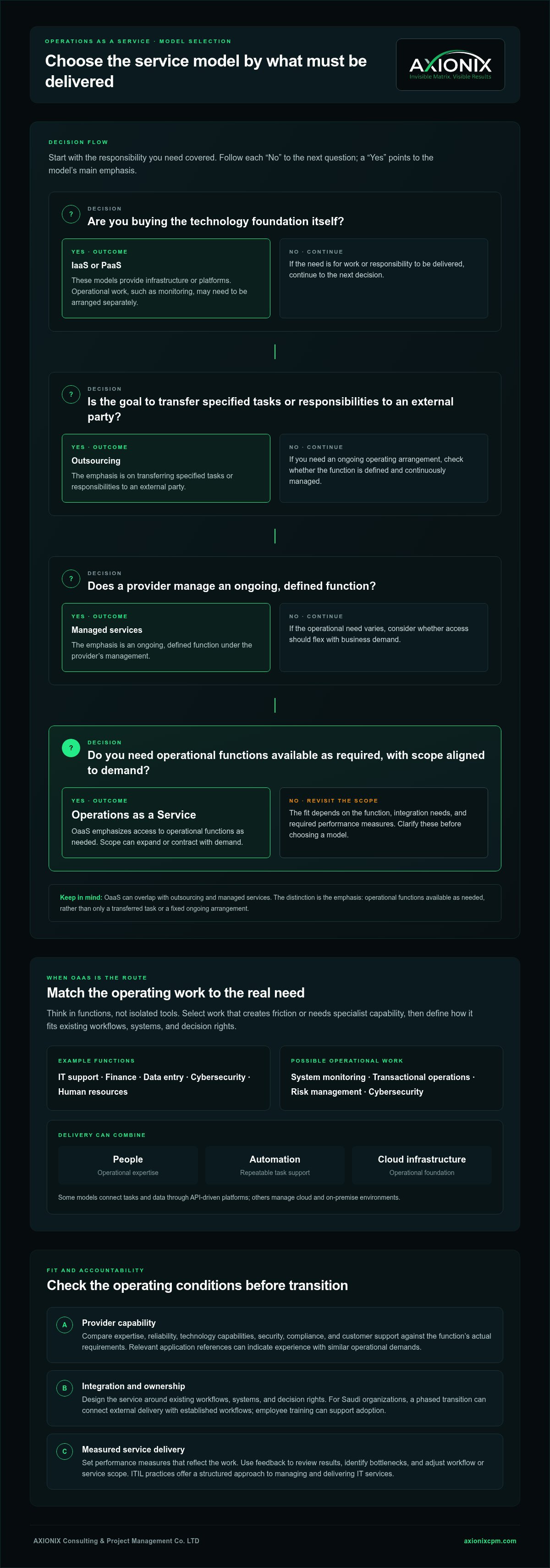
Operations as a Service (OaaS) gives an organization access to operational functions as needed. Instead of building every capability internally, it can align external delivery with business needs.
On-Demand Operational Functions
OaaS provides access to operational work as required, rather than requiring every function to be maintained in-house. This distinction matters when workloads shift or specialist capabilities are needed for a defined purpose. For example, a business can use external system monitoring instead of assigning the task to an internal team. Scope can expand or contract with demand without additional capital expenditure.
Think in functions, not isolated tools. IT support, finance, data entry, cybersecurity, and human resources are examples of work organizations may outsource. A business with an income-generating application but no employee responsible for maintaining it may need operational support for that application. The key question is which function creates friction and whether external delivery can address it.
OaaS Service Types and Delivery
OaaS can combine people, automation, and cloud infrastructure to deliver operational work. A service may cover system monitoring, transactional operations, risk management, or cybersecurity. Some models use API-driven platforms to connect tasks and data; others manage cloud and on-premise environments. The delivery design matters because each function must fit existing workflows, systems, and decision rights.
When assessing an OaaS provider, compare expertise, reliability, technology capabilities, security, compliance, and customer support with the function’s actual requirements, such as monitoring an application or processing finance workflows. Relevant application references can show whether the provider understands similar operational demands. The right fit depends on scope, integration needs, and the performance measures you require.
Agile delivery keeps a service responsive through feedback and measured improvement. A team can review operational results, identify a bottleneck, then adjust a workflow or service scope. For example, recurring incidents may prompt a review of the system-monitoring process. This feedback cycle keeps the service connected to actual work rather than assumptions made during setup.
Comparing OaaS With Other Service Models
Outsourcing usually transfers specified tasks or responsibilities to an external party. Managed services often put an ongoing, defined function under a provider’s management. OaaS can overlap with both, but emphasizes access to operational functions as needed. The distinction matters: an organization may need flexible operational capability, not simply a transferred task or fixed service arrangement.
OaaS also differs from Infrastructure as a Service (IaaS) and Platform as a Service (PaaS). Those models provide infrastructure or platforms; OaaS delivers operational functions that can run on those foundations. A company might use cloud infrastructure while separately arranging system monitoring and operational support. Separating the layers clarifies who supplies the environment and who performs the work.
For Saudi organizations, the architecture should reflect the function’s business context and existing systems. A phased transition can integrate external delivery with established workflows, while employee training supports adoption. ITIL practices offer a structured approach to managing and delivering IT services. Clear ownership, feedback channels, and measurable outcomes help keep operational changes aligned with business priorities.
Optimizing digital operations efficiency and cost
Digital efficiency comes from removing friction across connected processes, not automating isolated tasks. In Saudi Arabia, define the operational outcome first, then align workflows, capacity, and measurement.
Improving Service Operations Efficiency
Service operations become more efficient when teams reduce repetitive work and shorten the path from request to resolution. Automation can handle routine incident management, ticketing, and customer support, leaving staff to focus on complex cases.
For example, automated acknowledgements confirm receipt of a customer request, while resolution-time tracking shows where delays persist. If service processes span disconnected systems, integration and workflow redesign can reduce repeated data entry. The goal is a coherent operating flow, not another layer of tools.
Efficiency and Profitability
Operational efficiency supports profitability by reducing the effort required to deliver each service. Faster resolution can reduce repeat work, while fewer manual handoffs give teams more capacity for customer needs. These mechanisms matter because cost and service quality depend on how work moves through the operating model.
Fragmented service operations can lead to longer resolution times, repeat visits, billing inaccuracies, and revenue leakage. A finance team reconciling delivery across separate systems spends time resolving inconsistencies instead of improving financial accuracy. Track service performance alongside billing outcomes to see where operational friction affects business results.
Reducing Operational Costs
Cost savings may come from reducing hiring, infrastructure, and training overhead. Automation can reduce manual handling in repeatable processes, while cloud infrastructure can avoid extensive on-premises hardware. Compare the full cost of delivering a function, including its systems, staff effort, and ongoing training.
Do not treat every automated task as a saving. Automating customer support, for example, may shift costs into integration and maintenance. Map the current process first, then compare its operating demands with the redesigned workflow. This shows whether the change removes work or merely relocates it.
Using Analytics to Locate Friction
Operational analytics can provide real-time performance insights, help refine workflows, and forecast trends. A service team can compare ticket volumes with resolution times, then identify where work accumulates. These signals make process improvement a measured operating discipline rather than a broad technology initiative.
Set a baseline before changing a workflow. Then monitor service performance and customer satisfaction as processes evolve. For example, if automated ticketing increases throughput but customer satisfaction declines, the workflow needs adjustment. Analytics are useful when they connect operational activity to outcomes leaders can act on.
Aligning Capacity With Demand
Automated scaling adjusts resources as workloads change. This can align operating capacity with demand instead of maintaining enough resources for peak activity at all times. For example, a digital service with variable traffic can scale its environment in response to workload, limiting unused capacity during quieter periods.
For organizations assessing an external operating model, operational service delivery can be considered alongside internal process redesign. Define the target outcome, identify the functions creating friction, and measure results against the original baseline. That sequence helps leaders distinguish durable efficiency from temporary reductions in visible workload.
Data security, compliance, and service-level agreements
External operations shift work across organizational boundaries, but accountability still needs a defined structure. For Saudi organizations, assess data access, handling, retention, and incident responsibilities before connecting an external service to internal systems. A finance workflow, for example, may expose customer or transaction records to several operational roles. Map each data flow and assign responsibility for every access point.
Security Controls and Data Access
Encryption, access controls, and regular audits are practical foundations for protecting sensitive information. Define which users can view, change, or export data, then grant access according to their operational roles. If an external team monitors a system, its permissions should match that task, not extend across unrelated environments.
Zero-trust models, regular audits, and automated policy enforcement can help address security and compliance concerns. Organizations should also establish how backups are checked and security patches are handled. For example, an urgent application patch needs an assigned owner, a deployment process, and a record of completion. These controls make reducing exposure part of day-to-day operations.
Compliance Across Operational Boundaries
Compliance depends on the data, activity, and jurisdictions involved. GDPR and HIPAA are examples of rules providers may need to meet when protecting sensitive data; ISO standards are examples of relevant standards. These are not interchangeable requirements. A Saudi business should map its obligations and data flows, then define how the service’s controls support its compliance context.
Document who handles access requests, audit evidence, retention decisions, and incident escalation. For instance, if a customer record moves between a business system and an external processing workflow, record the transfer and the responsible roles. A clear responsibility matrix helps prevent gaps between internal governance and external delivery.
Service Levels and Operational Resilience
A service-level agreement (SLA) defines expected performance, including response and resolution times. Response time measures how quickly a service team acknowledges an inquiry or issue. Resolution time measures how long it takes to resolve the issue from start to finish. These are distinct measures, so define each separately rather than combining them into one service target.
Set measurable KPIs and performance benchmarks in the SLA. For a service desk, measures could include acknowledgement speed, resolution time, and compliance with agreed service levels. Monitoring can track response times, customer satisfaction, and SLA performance. Regular reviews show whether service delivery is meeting operational needs or creating new bottlenecks.
Resilience also requires a backup plan and clear incident ownership. Specify how teams communicate during disruption, who coordinates recovery, and how progress is reported. Incident management aims to restore normal IT services quickly; problem management targets the root causes of recurring issues. Together, these practices link immediate recovery with longer-term stability.
Digital operations expertise and application references
Operations as a Service requires more than technical access. The provider’s expertise must fit the work, systems, and operating context the organization needs to transform.
IT, healthcare, finance, and retail are among the industries adopting OaaS to improve efficiency and reduce operational overhead. Their needs differ: a finance operation may prioritize accurate processing, while a retailer may focus on dependable customer-service workflows.
Expertise That Fits the Operating Context
Assess expertise against the function being delivered, not broad claims of digital capability. A provider supporting system monitoring needs relevant operational knowledge, while one handling transactional operations needs to understand the process and its dependencies. This fit determines whether external expertise can work within the organization’s existing operating fabric.
Communications service providers and systems integrators can bring digital operations experience, application references, and services. For an enterprise transforming a service workflow, relevant references can show how that experience applies to comparable applications or processes. Examine the work described, the operational challenge, and the service delivered, rather than relying on a logo or general reputation.
Application References in Practice
An application reference should connect expertise to a real operating requirement. For example, a business assessing system monitoring can look for experience with monitoring practices, incident handling, and service continuity. A reference describing the application and operational context offers a more useful comparison than one that names technology without explaining its role.
Start with the function’s demands. Identify its systems, users, handoffs, and performance expectations. Then compare those demands with the provider’s application experience. A customer-support workflow spanning several systems, for instance, requires understanding how information moves between them and affects staff decisions.
Evaluating Capability and Fit
Assess provider expertise, reliability, technological capabilities, security measures, compliance, and customer support. Map these criteria to the function’s actual operating risks. For example, an organization using cloud-native solutions should evaluate whether the provider’s technical capabilities match that environment and its integration requirements.
Startups may gain access to AI-driven monitoring, cloud-native solutions, and advanced DevOps practices through OaaS. Access alone does not create a sound operating model. Leaders still need to define service scope, ownership, and how performance will be assessed. Those decisions connect external capability with internal accountability.
Application references are most useful when they inform a specific decision. Compare the provider’s experience with the business process being transformed, then identify gaps in expertise or technology. This disciplined assessment helps organizations distinguish transferable capability from experience that merely sounds relevant.
OaaS benefits for established enterprises
For established enterprises, OaaS can add specialist operational capacity without requiring those professionals to be full-time employees. It can also support functions across complex organizations where internal teams already manage substantial workflows.
Potential benefits include access to expertise, reduced hiring and training overhead, and support for business continuity. Risks include dependence on an external provider, difficult integration, and weaker control when responsibilities are unclear. These trade-offs matter because enterprise operations connect systems, teams, and customer commitments.
Specialist access can help when internal capability is limited or demand changes. For example, an enterprise may use an external team for system monitoring while its own staff focus on core business processes. Define where external work begins, where internal ownership remains, and how both teams coordinate.
That boundary needs to fit existing workflows. A finance function, for instance, may depend on information from sales, service, and billing systems. If external delivery creates duplicate records or manual handoffs, it adds friction rather than removing it. Map dependencies and decision rights before transferring work, then assess whether the new arrangement improves visibility and control.
Operational resilience is another potential benefit. Disaster recovery solutions can help protect data and maintain business operations during unexpected events. Their value depends on how recovery responsibilities connect to the organization’s systems and continuity plans. Define who coordinates recovery, how teams communicate, and how service restoration is measured.
Security and compliance need particular attention in enterprises operating across geographies. OaaS providers can support compliance across multiple locations, including requirements involving ISO, GDPR, and HIPAA. Those frameworks do not replace an organization’s own governance. Assign responsibility for access, audit evidence, data handling, and escalation within each operating relationship.
Integration can create risk when external processes meet established systems. A phased transition can limit disruption: begin with a contained function, observe its handoffs, and expand only when responsibilities and performance are clear. Regular reviews should examine service outcomes, recurring issues, and whether internal teams retain the context needed to govern the operation.
Established enterprises should treat OaaS as an operating design decision, not a simple capacity purchase. Define the function, map its dependencies, and set ownership before expanding external delivery. Discuss an OaaS operating model when your organization needs to align external operational capacity with established workflows.
Operations as a Service provides digital operations support for enterprises and organizations undergoing digital transformation. A phased approach, along with standardized APIs and protocols, can help maintain stability.
AXIONIX Consulting & Project Management: Operations as a Service (OaaS)
AXIONIX Consulting & Project Management Co. LTD provides Operations as a Service (OaaS) for organizations seeking structured operational capacity without building every function internally. Its integrated approach connects operational capabilities, helping businesses align delivery with their objectives and existing workflows.
Turn to OaaS when operational responsibilities create friction, capacity needs fluctuate, or internal teams need a more coherent operating model. Business Consulting and Transformation can help assess how work should change. Feasibility Studies can help evaluate whether a proposed operational model fits its intended purpose before implementation.
Start by defining the functions in scope, the outcomes they need to support, and how delivery will be assessed. This gives you a clear basis for aligning capability, accountability, and performance.
To discuss an operating model suited to your organization, contact AXIONIX Consulting & Project Management Co. LTD.
Design the Operating Model for What Comes Next
The next operating model should protect leadership attention for work that shapes the organization’s future. Decide which capabilities need to remain close to strategic decisions and which can operate as shared infrastructure. That distinction gives growth a deliberate structure instead of adding another layer of internal complexity.
Use operations as a service as a design choice, not a default response to pressure. Start with the operating outcome you want to strengthen, then define how external delivery should support your people, systems, and priorities. The model should fit the organization’s direction, not force its strategy around a service arrangement.
AXIONIX Consulting & Project Management Co. LTD offers Operations as a Service, Business Consulting, and Transformation to support organizations shaping that operating model. Contact AXIONIX Consulting & Project Management Co. LTD to discuss how your next phase of operations can be structured with purpose. A clear operating design is a strong foundation for sustained progress.
Frequently Asked Questions
What does operations as a service mean?
Operations as a Service means accessing operational functions through an external delivery model instead of building every capability internally. The organization defines the work and its boundaries, while the service arrangement provides operational capacity. For example, a company might arrange external support for a digital process while keeping policy decisions and business ownership in-house. This separates execution from governance without treating the function as a standalone software purchase.
What services are included in operations as a service?
Included services depend on the organization’s needs and the model’s scope. Examples include IT support, cybersecurity, human resources, finance operations, data entry, and system monitoring. A business may also arrange transactional processing or risk-management support. For instance, an organization could externalize routine finance processing while retaining approval authority internally. Define the function, related systems, decision rights, and handoffs before work moves between teams.
How does an operations as a service engagement work, from onboarding to ongoing delivery?
A sound engagement moves from scope definition to transition, operational delivery, and review. First, document the tasks, systems, decision rights, and information the function requires. Next, align access and handoffs, then introduce the work in a controlled phase. For example, a company transferring invoice processing can keep approvals internal while transitioning routine data handling. Ongoing reviews assess workflow issues and changing business needs, keeping the arrangement aligned.