Avoid Building Internal Departments by Aligning Structure with Core Functions

Building a department for every operational need can duplicate resources and blur accountability. To avoid building internal departments, organize around the core functions your strategy requires, then assign each function clear ownership, authority and performance measures. Add capacity where the work demands it, not simply another management layer.
Growth requires coordination, clear responsibilities and reliable delivery. But creating separate teams before mapping the work can multiply handoffs, systems and costs without improving how the business operates.
This article explains how to align your structure with core functions and prevent departments from repeating work. You’ll learn how to identify essential functions, clarify decision rights, share resources appropriately and recognize when a dedicated internal department is justified. The goal is not to keep every team small. It is to build an operating structure that serves the strategy without unnecessary duplication.
Key Takeaways
- Start with the functions your strategy requires, then define ownership, authority and measures of success before assigning people or creating departments.
- Map overlapping responsibilities and shared resources to expose duplication; align team goals so each function contributes to the same business priorities.
- Compare outsourcing with an internal department by assessing the full operating model, including management, coordination and the capability the work requires.
- Evaluate a provider’s scope, accountability and integration with your processes before shifting operational work outside the organization.
- Protect continuity and decision clarity by documenting processes, defining information flows and retaining appropriate oversight of outsourced work.
Table of Contents
- 1. The relationship between organizational structure and core functions
- 2. Avoiding duplicated departments and resources
- 4. How do outsourcing costs compare with hiring and running an internal department?
- 5. How to choose and vet an outsourcing provider in South Africa?
- 5. What are the risks and disadvantages of outsourcing instead of building an internal team?
- AXIONIX Consulting & Project Management: Operations as a Service (OaaS)
1. The relationship between organizational structure and core functions
Organizational structure is the operating map for the work required by business strategy. Start by listing core functions, then define each function’s authority, accountability and key performance indicators. A Saudi business pursuing regional expansion, for example, may need clear ownership for customer delivery and market development before it adds management layers. Structure should follow those requirements, not the preferences of particular individuals.
A functional structure groups employees by specialization, such as finance, marketing or human resources. It can support specialized efficiency, especially when teams share expertise across the organization. But structure must also locate each function where it can serve strategy: long-range development should not report to a function judged only on short-term results. Jessica During says a flat organisational structure is ineffective once a company has more than 20 people. That is a prompt to assess coordination needs, not a universal instruction to add managers.
Plan the structure before hiring managers. First, map essential activities and decision points. Then assign one accountable owner to each outcome and identify the roles and reporting relationships needed to deliver it. A RACI matrix can clarify who is Responsible, Accountable, Consulted and Informed for each key process. Give each employee one primary role. Secondary duties can suit a smaller organization, provided ownership remains clear.
Organizational change also requires fair role placement and practical training. Match each person’s experience and working style to the function’s actual requirements, then explain changed responsibilities and decision rights. If an employee moves from finance operations into planning, provide training on the new processes before expecting full performance. Nearly 60% of managers received no training when they initially assumed a leadership role, according to research from the Center for Creative Leadership. Training helps leadership implement the design instead of reproducing old reporting habits.
Which functions should a business keep in-house rather than outsource? Keep strategic decision-making, proprietary knowledge and functions that directly shape customer value under clear internal ownership. For example, a company may retain product priorities while using external capacity for repeatable administrative processes.
What service-level agreements and contract terms should outsourcing agreements include? Define the service scope, measurable outputs, response and resolution expectations, reporting, escalation routes, data handling, continuity arrangements and exit responsibilities. These terms make accountability visible and support working relationships if delivery changes.
Operational efficiency comes from aligned work, not simply fewer departments. Check whether teams duplicate tasks, wait for approvals or receive conflicting instructions. Then adjust authority and reporting lines, balancing autonomy with control. To avoid building internal departments around temporary workloads, see whether existing functions can take on the work without compromising accountability or service quality.
2. Avoiding duplicated departments and resources
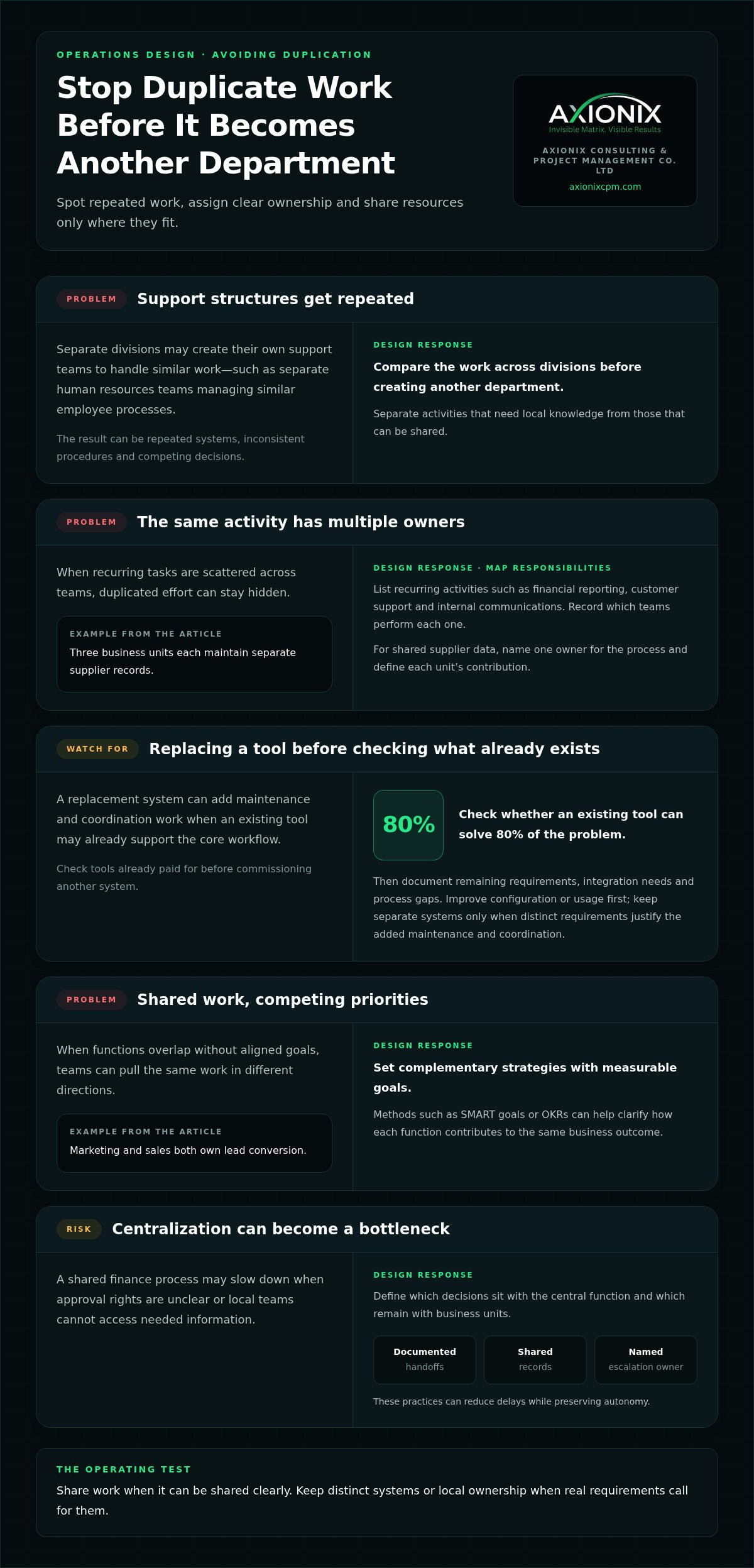
Departments often duplicate work when each division builds its own support structure. A divisional organization might create separate human resources teams for different business units, even when they handle similar employee processes. The result can be repeated systems, inconsistent procedures and competing decisions. Before adding a department, compare work across divisions and identify which activities require local knowledge and which can be shared.
Start with a responsibility map. List recurring activities such as financial reporting, customer support and internal communications, then record which teams perform them. If three business units maintain separate supplier records, for example, assign one owner to the shared data process and define each unit’s contribution. This makes duplicated effort visible without overlooking genuine differences in customer needs or operating conditions.
Apply the same test to tools and infrastructure. Before commissioning a replacement system, check whether a tool already paid for can solve 80% of the problem. Then document the remaining requirements, integration needs and process gaps. If the existing tool supports the core workflow, improve its configuration or usage before creating another platform. Separate systems should exist only when distinct requirements justify their additional maintenance and coordination.
Shared resources need shared priorities. Use measurable goal-setting methods such as SMART goals or OKRs to help leaders set complementary strategies and prevent overlapping work. If marketing and sales both own lead conversion, for instance, define how each function contributes to the same outcome. Clear measures encourage collaboration, make decisions easier to trace and show everyone which activities matter most.
Centralization alone does not guarantee efficiency. A shared finance process can become a bottleneck if approval rights are unclear or local teams cannot access the information they need. Define which decisions belong to the central function and which remain with business units. Documented handoffs, shared records and a named escalation owner can reduce delays while preserving appropriate local autonomy.
Review the design when strategy, workload or processes change. Compare current activities with organizational goals, then consolidate overlapping ownership or redistribute work where the evidence supports it. Track duplicate software, repeated reporting and parallel approval chains as practical signals. These indicators can show whether a resource supports distinct work or simply reflects an inherited structure.
Training helps employees adopt a shared process instead of recreating local versions. Explain the new workflow, decision boundaries and escalation path, then gather feedback from the teams using it. Structured cross-functional training can support collaboration when roles or processes change. The aim is to avoid building internal departments for work that existing functions can manage effectively, with clear accountability and the right resources.
4. How do outsourcing costs compare with hiring and running an internal department?
Compare the full operating model, not a supplier’s fee with one employee’s salary. An internal department brings connected costs: recruitment, compensation, onboarding, management time, equipment, systems and ongoing training. When building an internal finance function, include the time leaders spend coordinating its reporting and approvals. An outsourcing comparison should account for equivalent scope, oversight and integration effort.
Build the comparison around the work itself. First, define the service outputs, required capacity and quality measures. Then estimate the internal resources needed, including supervision and continuity during leave or turnover. If customer queries arrive unevenly, for example, a permanent team may have unused capacity during quiet periods. Assess a contracted service against the same workload pattern and service requirements.
Separate setup costs from recurring costs. An internal department may require initial recruitment, process design and system configuration before routine delivery begins. Outsourcing may require transition planning, knowledge transfer and process integration. A procurement team operating nationwide across Saudi Arabia, for example, should record the effort needed to move supplier records, approval routes and reporting into the new operating arrangement. Omitting transition work makes either option appear artificially inexpensive.
Assess costs over the period the business expects to need the capability. A short-term transformation project differs from a permanent function supporting core operations. Internal capability can make sense when demand is steady, specialized knowledge must stay close to decisions, or work depends on confidential institutional context. External delivery may suit repeatable processes with variable demand, provided the business retains clear ownership and oversight.
Test the comparison against realistic operating scenarios, not just one forecast. Model a quiet period, a rise in demand and a disruption to delivery. For each scenario, identify who absorbs additional workload, resolves service failures and provides management attention. A business expanding into a new market, for instance, should account for the coordination needed to adapt processes while sustaining existing operations.
Use a consistent decision record. List the internal roles and infrastructure required, the external scope and service measures, transition effort, management responsibilities and exit requirements. Then compare which model supports quality, responsiveness and strategic control at the required level. The lowest visible charge is not automatically the lowest total burden. An internal team is not inherently more economical simply because its costs sit inside payroll.
Revisit the decision when workload, strategy or process complexity changes. A capability outsourced during a temporary demand spike may later become central to business differentiation. Conversely, a department created for a past expansion may now duplicate work done elsewhere. Review actual utilization, recurring handoffs and leadership time. That evidence helps executives contain unnecessary overhead without weakening essential functions.
5. How to choose and vet an outsourcing provider in South Africa?
For an organization operating in Saudi Arabia, assess operational fit before comparing proposals. Begin with a defined scope: specify whether the provider handles invoice processing, reporting, or both. Record expected outputs, internal dependencies, decision boundaries and service-quality measures. For example, a Saudi retailer may need a provider to process supplier invoices while its finance team retains approval authority. A precise scope exposes gaps between the work required and the work proposed.
Test relevant experience against your operating model. Ask the provider to explain a sample workflow, such as receiving an invoice, resolving a discrepancy and delivering an approved report. Look for a clear sequence, named responsibilities and an escalation path. A polished presentation matters less than whether the process connects with your teams and systems. Request sample outputs showing how exceptions and incomplete records are handled.
Examine delivery governance before selecting a provider. Identify the operational lead, reporting cadence, issue owner and route for escalating unresolved problems. For a provider supporting teams across Saudi Arabia, define how handoffs and urgent requests will be managed across business units. A sample reporting pack can reveal whether performance updates will support decisions or merely describe activity.
Review service levels and contract structure against the work. Specify scope, deliverables, quality criteria, reporting, change control, confidentiality, data handling, continuity planning and exit responsibilities. If the provider maintains customer records, define who can access them and how those records transfer when the arrangement ends. Have qualified advisers review terms relevant to the service and applicable Saudi requirements.
Assess resilience through practical scenarios. Ask how the provider would respond to a system outage, a key-person absence or a sudden rise in workload. Request a continuity explanation tied to your process, not a generic policy statement. For example, a payroll support workflow needs documented inputs, review ownership and a fallback route if required files arrive late.
Check references and evidence in proportion to the assignment. Discuss comparable work, delivery challenges and how the provider resolved them. Review sample outputs, process documentation and the proposed implementation plan. A transition plan should identify knowledge transfer, access requirements, internal owners and acceptance criteria. These details expose execution risks before responsibilities move across organizational boundaries.
Finally, compare providers using consistent criteria. Assess scope fit, process clarity, governance, continuity, communication and transition readiness. Record unresolved issues and assign an owner for each before approval. The best fit is the provider whose operating model supports your objectives while preserving clear internal accountability. For Saudi organizations, design the working arrangement around the teams, processes and operating requirements involved from the outset.
Provider selection also involves balancing expectations across the people affected by the arrangement. Organizations working with partners like AXIONIX Consulting & Project Management Co. LTD should recognize that aligning stakeholder needs is critical to long-term success. Apply practical realism when gathering stakeholder input: identify the requirements that matter most to service delivery, and assess proposals against those priorities rather than expecting one provider to satisfy every individual preference.
5. What are the risks and disadvantages of outsourcing instead of building an internal team?
Outsourcing transfers execution, not accountability. If a Saudi retailer outsources customer support, its leaders still own customer outcomes, priorities and escalation decisions. Confusion begins when internal teams assume the provider owns decisions that remain with the business. Define decision rights, approval boundaries and a named internal owner before work moves. Without that structure, routine questions can circulate between teams while customers wait for resolution.
External delivery can also weaken institutional knowledge. A provider may process requests without understanding why a particular customer, supplier or exception matters. An outsourced finance team might flag an unusual invoice but lack context about a project commitment. Document process rationale, exceptions and key relationships, then establish how staff can access that knowledge. Otherwise, changing providers or bringing work back inside can disrupt continuity.
Information access needs deliberate controls. A provider handling employee records or customer files needs clear instructions on permitted access, storage, transfer and retention. Map the information each role needs, then limit access to that scope. For a cross-border arrangement, specify how information moves between teams and who handles an incident. A general confidentiality clause does not explain the actual workflow or safeguards.
Service quality may vary when performance measures are vague. A provider could close support tickets quickly while leaving underlying customer problems unresolved. Define outcomes that reflect the real service, such as accurate processing, complete records and effective resolution. Review sample outputs and recurring error patterns. A regular review can examine trends, open issues and corrective actions without creating another parallel department.
Coordination creates friction when internal and external processes do not align. A delayed handoff between a Saudi operations team and an overseas provider may leave a request unowned. Map each transition, identify the receiving role and set an escalation route. Also account for differences in working schedules and communication practices. A process map should show who acts next, what information they need and how unresolved work returns to an accountable owner.
Continuity is another risk. If a key provider contact becomes unavailable, undocumented procedures can stall delivery. Require process documentation, access arrangements, backup responsibilities and an orderly exit plan. Then test those arrangements against a realistic disruption scenario. Retain internal understanding of critical workflows, even when execution sits outside the organization. That knowledge gives leadership a basis for oversight and transition.
Outsourcing fits poorly when work depends on confidential judgment, constant strategic decisions or deep tacit knowledge. The answer is not automatic insourcing; it is deliberate control over the capability. Before committing, map dependencies, failure points and retained responsibilities. Assess your operating model to identify where external delivery could create structural risk.
AXIONIX Consulting & Project Management: Operations as a Service (OaaS)
AXIONIX Consulting & Project Management helps organizations align operational capability with core functions through Operations as a Service (OaaS). Turn to this model when essential work needs clear ownership and coordination, but building another internal department would add unnecessary overhead.
Business Consulting and Strategic Advisory can help assess where responsibilities, processes and resources should sit. For a proposed change, Transformation and Feasibility Studies can support operating-model decisions before implementation. The objective is not to outsource every function. It is to connect the capabilities the business needs with a structure that fits its strategy.
To discuss how this approach could fit your organization, contact AXIONIX Consulting & Project Management.
Design the Next Stage of Growth
Make the next structural decision with a forward view: which capabilities will distinguish the organization as its strategy evolves? Build the operating model around that direction, not yesterday’s reporting lines. To avoid building internal departments that constrain rather than enable growth, design the structure deliberately and recalibrate it periodically.
AXIONIX Consulting & Project Management Co. LTD offers Operations as a Service (OaaS), Business Consulting and Transformation to help organizations shape operational capability around their requirements. These options can connect work, ownership and execution without defaulting to another internal layer.
Bring your operating challenge into focus and consider the structure it requires. Contact AXIONIX Consulting & Project Management Co. LTD to discuss the next step for your organization. A well-designed operating model gives growth a stronger foundation.
Frequently Asked Questions
What are alternatives to building internal departments?
Alternatives include shared services, cross-functional teams, external specialists and managed operational support. A company launching a new reporting process, for example, could assign a finance lead and operations lead to a temporary project team rather than create a permanent department. Operations as a Service (OaaS) is another option when a business needs coordinated operational capability without establishing a separate internal function.
What business functions can companies outsource or use managed services for?
Companies can outsource repeatable operational activities such as transaction processing, routine reporting, customer support or administrative coordination, provided responsibilities and oversight remain clear. Managed services can also support capabilities such as business intelligence or performance improvement. For example, a leadership team might use external business intelligence support to organize operational data while retaining decisions about strategy and investment priorities.
What steps are involved in outsourcing a business function?
Start by defining the business problem and the outcome the function must deliver. Map its inputs, users, dependencies and exceptions, then determine which decisions stay internal. Next, set evaluation criteria, agree on scope and measures, and plan the transfer of process knowledge and access. After launch, review actual outputs against agreed measures and use recurring issues to refine the operating arrangement.