Managed Operational Departments: Roles, Processes, and Value

Operational performance depends on how well departments work as one system. Managed operational departments coordinate functions such as finance, HR, IT, facilities, and inventory around shared business goals. Operations management connects daily work to supply chains by aligning workflows, resources, and the movement of goods and services.
It’s easy to see operations as a collection of tasks. The harder question is how those tasks fit together, where friction builds, and which processes need to change. This article explains what operations management does, how it differs from project management, and how it connects internal teams with sourcing, logistics, and delivery.
You’ll also see how clear processes, performance measures, and continuous improvement support efficiency, productivity, and customer satisfaction. The central idea is structural: sustainable performance comes not from adding activity, but from aligning the operating system.
Key Takeaways
- See how operations management aligns departments around shared goals, clear responsibilities, and coordinated daily work.
- Trace how internal workflows connect with sourcing, inventory, logistics, and delivery across the supply chain.
- Distinguish ongoing operational oversight from project management, which focuses on work with a defined start and end.
- Learn how performance measures and process reviews reveal friction, guide improvements, and support customer satisfaction.
- Understand when an Operations as a Service model can help structure operational capabilities without building every function internally.
Table of Contents
What Is Operations Management?
Operations management coordinates the people, processes, and resources that keep an organization functioning. Its central task is aligning departments so business operations support shared goals.
Managed Department Models
A managed department is an operational function overseen through an external arrangement, with responsibilities and performance expectations defined between the business and provider. Unlike an in-house team, it does not rely solely on employees managed within the organization. Unlike business process outsourcing, it can include operational oversight, coordination, and process improvement, rather than only delegated tasks.
The distinction matters when deciding how to organize a function. A Saudi business, for example, might retain finance leadership internally while assigning recurring workflow oversight to a managed arrangement. Compare decision authority, internal knowledge, accountability, and cross-department handoffs before selecting the model. These criteria help clarify whether the need is task execution or broader operational coordination.
Outsourcable Operational Departments
Operational departments are functions responsible for recurring work that enables an organization to deliver products or services. Depending on its activity and operating model, a business may manage finance, HR, IT, facilities, inventory, or customer-service operations externally.
The right boundary depends on how a function connects to core decisions. Inventory processes, for instance, need coordination with procurement and logistics, while finance workflows depend on accurate records from other teams. Map each handoff, decision owner, and required information before assigning a function to managed oversight. This shows where external coordination can fit without obscuring internal accountability.
How Managed Departments Work
Managed departments work through defined responsibilities, coordinated workflows, and regular performance review. In Saudi Arabia, applicable requirements depend on the function and activity; compliance planning should account for relevant employment, personal-information, financial-control, and sector-specific considerations.
In practice, the business defines departmental ownership, documents procedures, and aligns reporting with priorities. When choosing a managed operations provider, assess the proposed scope, accountability structure, performance measures, and approach to coordinating cross-functional handoffs. For example, a finance workflow needs a clear route for escalating discrepancies and sharing relevant information with authorized decision-makers.
Operational skills make this model work. Managers need strategic planning to connect departmental targets with organizational goals, problem-solving to address process failures, and leadership to coordinate people across functions. Technology and data-analysis skills help them interpret performance information and identify workflows that need adjustment. A reporting review, for example, can show whether a delay stems from incomplete inputs or an unclear approval path.
Coordination becomes concrete at departmental boundaries. If HR plans workforce capacity, IT prepares the required systems, and facilities supports the work environment, each function must share relevant timing and requirements. Clear ownership, agreed procedures, and consistent reporting help teams respond to operational changes without creating conflicting priorities.
Operations and supply chain management
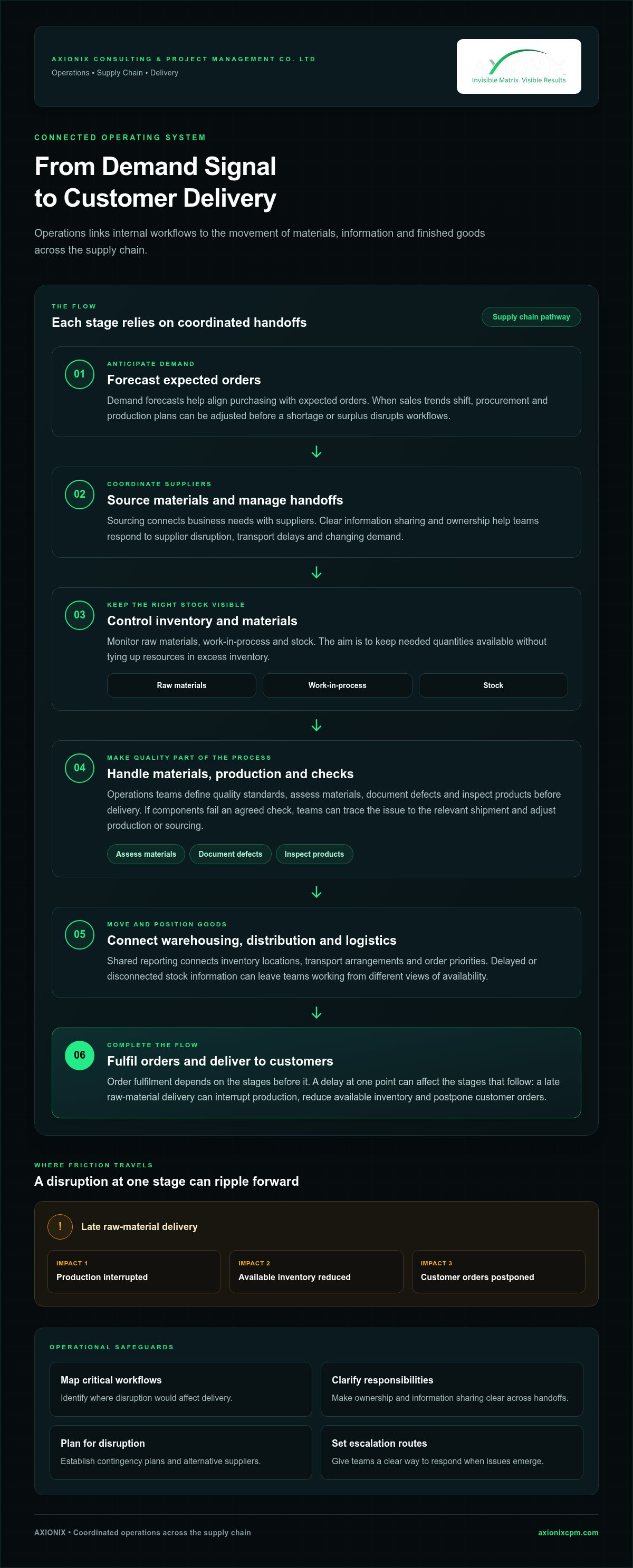
Operations management connects internal workflows with the movement of materials, information, and finished goods. Supply chain management extends that coordination across sourcing, materials handling, warehousing, distribution, logistics, and order fulfilment. A delay at one stage can affect every stage after it. For example, a late raw-material delivery can interrupt production, reduce available inventory, and postpone customer orders.
Inventory control is a central link between operations and supply chains. Teams monitor stock, work-in-process, and raw materials to keep needed quantities available without tying up resources in excess inventory. Demand forecasts help align purchasing with expected orders. If sales trends shift, procurement and production plans can be adjusted before a shortage or surplus disrupts workflows.
Quality control also links suppliers to customer outcomes. Operations teams define quality standards, assess materials, document defects, and inspect products before delivery. If a supplier’s components fail an agreed quality check, the business can trace the issue to the relevant shipment and adjust production or sourcing. This makes quality a process responsibility, not merely a final inspection.
Supply chain risks include supplier disruption, transport delays, unexpected demand changes, and quality failures. Outsourcing operations can add risks involving unclear responsibilities, information sharing, service continuity, and dependence on a provider. Businesses should map critical workflows, identify where disruption would affect delivery, and establish contingency plans, alternative suppliers, and clear escalation routes.
For a business serving customers across Saudi Arabia, distribution planning must connect inventory locations, transport arrangements, and order priorities. A shortage at one warehouse can affect fulfilment elsewhere if stock information is delayed or disconnected. Shared reporting helps procurement, warehouse teams, and customer-facing functions respond to the same inventory picture.
Capacity planning supports these decisions by comparing workload with available resources. When forecasts show rising demand, operations teams can assess production capacity, stock requirements, and distribution constraints together. This prevents one function from expanding its workload while another remains unable to fulfil the resulting orders.
Managed operational oversight can help coordinate procurement, logistics, supplier relationships, and inventory processes as connected functions. The useful measure is not activity within one department, but whether the full chain moves reliably from sourcing to customer delivery. Businesses assessing this model can explore integrated operational planning as a way to examine how supply chain workflows align.
Effective coordination relies on strong vendor relationships. Operations departments oversee day-to-day workflows, capacity planning, and inventory control. Operations managers can manage supply chain risks by developing contingency plans, diversifying suppliers, and implementing risk management strategies. Operations management aims to optimize resource use and reduce waste in areas such as materials, inventory, and labor costs. These responsibilities connect routine decisions with broader planning and resource choices.
Lean production, just-in-time inventory, and outsourcing are methods operations management can use to control costs. Vendor-managed inventory allows suppliers to manage inventory on a company’s behalf. Operations management functions include operational planning, financial management, product design, quality control, forecasting, strategy development, and supply chain management. Together, these functions cover the planning and oversight needed to coordinate resources, products, quality, and supply chain activity.
Operations management definition and purpose
Operations management designs, plans, and controls processes that turn inputs into products or services. In manufacturing, these inputs include materials, labour, equipment, and production information. The function connects resources to outputs customers can use. Its purpose is not simply to keep activity moving, but to align capacity, quality, cost, and delivery with organizational goals.
The operating system extends beyond the factory floor. A service organization also transforms inputs: staff time, customer information, and digital tools become completed work or customer support. For example, a finance team receives transaction records, checks them, and produces reports. Operations management examines each stage, assigns responsibility, and addresses delays or errors that obstruct the intended outcome.
Operations management structures and controls work. Operational planning sets priorities, forecasting informs capacity, and quality control defines acceptable outputs. Financial management connects resources to budgets, while product design shapes what the organization delivers. These functions interact. A product change, for instance, may require revised materials, updated work instructions, and different quality checks.
Operations management differs from project management in its time horizon. Operations oversee recurring workflows, such as processing customer requests or replenishing inventory. Project management plans and executes defined work with a start and end, such as opening a new facility. Both disciplines require coordination, but operational decisions sustain the organization while project decisions deliver a bounded change.
Historically, operations management emerged from early twentieth-century manufacturing practices. Its core logic remains useful across sectors: design a process, allocate resources, monitor results, and adjust the system. A Saudi manufacturer might compare production capacity with forecast demand before scheduling work. A service business might examine queue times and staff availability before changing customer-request workflows.
Operational decisions rely on relevant information, not isolated departmental targets. A purchasing decision affects materials availability; a production decision affects capacity and quality; a delivery decision affects customer commitments. Managers need to assess these dependencies together. If production output rises while inspection capacity stays fixed, defects may move downstream instead of being resolved at their source.
The practical test is whether a process converts resources into useful outcomes with controlled variation. Managers can map the steps, identify handoffs, set performance measures, and review exceptions. For example, a delayed customer order can be traced through demand planning, inventory availability, production scheduling, and dispatch. This analysis shows where a decision can improve the system instead of merely shifting the delay.
Efficiency, productivity, and customer satisfaction
Managed operational departments can improve efficiency through dedicated oversight, defined workflows, and consistent performance reviews. They can also create drawbacks, including weaker access to internal knowledge, slower escalation, or unclear accountability. For example, a team handling customer requests needs clear ownership and timely access to product information, or service quality may fall despite efficient processing.
Productivity is not simply more output. It is useful output produced with available resources and acceptable quality. A production team can track completed orders alongside rework and defects. If output rises while defects also increase, the process is shifting costs downstream rather than improving performance. Reviewing both measures helps managers distinguish real gains from activity alone.
Demand forecasting links capacity to customer expectations. Teams can use order patterns and trend analysis to adjust production plans before workloads change. For a Saudi distributor, a rise in demand for a product can affect purchasing, warehouse capacity, and delivery scheduling. Coordinated adjustments help the business respond effectively without treating each department’s forecast as a separate plan.
Quality management makes customer experience operational. Teams define quality standards, inspect outputs, document defects, and route findings to the responsible function. If repeated packaging damage appears during delivery, the business can trace the issue through handling, storage, and dispatch. Correcting the relevant process addresses the cause, while recording complaints reveals whether the fix works over time.
Delivery performance depends on connected handoffs. Inventory accuracy supports order preparation; warehouse workflows support dispatch; logistics arrangements affect arrival. A delayed order should be reviewed across these stages, not automatically attributed to the final delivery team. Operations managers can compare fulfilment records with customer feedback to locate recurring friction and improve the process causing it.
Managed oversight can provide operational capability without requiring every function to be built internally. The trade-off is coordination: external teams need usable information, defined decision rights, and reliable contact with internal departments. If a customer complaint requires a product-quality decision, the escalation path must reach the team authorized to investigate and act.
Performance measures turn these issues into decisions. Track defect rates, process variance, delivery timeliness, complaint resolution, and customer satisfaction indicators together. A rise in complaints alongside stable delivery times may point to product functionality or communication, not transport. Reviewing measures as a set helps managers target improvements, allocate resources, and maintain customer experience as operations evolve.
Improvement reviews can span the operating system rather than focus on one department. Managers may consider plant size and layout, production processes, IT networks, project management, logistics and supply chain management, quality control, and customer service. Oversight may also include inventory, warehouse efficiency, legal compliance, budgets, forecasts, quality controls, and production KPIs. Looking across these areas connects capacity and service measures to the decisions that shape them.
Efficient supply chain operations can help ensure timely product delivery, while quality control helps ensure products or services meet or exceed customer expectations. Operations managers may follow up with customers about product quality and functionality and share relevant feedback with departments for improvement. Consistent quality control supports customer satisfaction KPIs and ongoing compliance with relevant regulations.
Operations management processes and continuous improvement
Operations processes turn business priorities into repeatable work, measurable results, and controlled adjustments. Continuous improvement keeps those processes responsive as demand, quality issues, and capacity change.
Operations Management Processes
Operations management processes establish how work is implemented, optimized, measured, and improved. The sequence matters: a change without measurement can shift delays instead of removing them.
Start by documenting a workflow, such as customer-order processing, from request through fulfilment. Identify each handoff, decision owner, delay, and defect. Then define a standard operating procedure so teams perform critical tasks consistently. After implementation, track relevant indicators, such as defect rates and process variance, to see whether the workflow performs as intended.
Review the evidence before changing the process. If order errors cluster during data entry, clarify that step or assess whether automation could reduce repetitive manual work. If delays occur at approval, examine the decision path and workload. Focused adjustments target the source of friction instead of adding controls across the entire workflow.
Quality management can make improvement continuous rather than occasional. Six Sigma was introduced by Bill Smith at Motorola in 1986 to improve manufacturing quality. It uses control limits six standard deviations from the normal distribution mean. An organization need not apply one method everywhere; its choice should match the process, quality issue, and available performance data.
Regular reporting closes the loop. Department leaders can compare performance with internal targets, document exceptions, and assign follow-up actions. For example, a rise in process variance can trigger a review of work instructions, training, or equipment. The next review tests whether the adjustment reduced the problem.
Setting Up a Managed Department
Setting up a managed department means defining its scope, operating procedures, accountability, and review measures before recurring work begins. This structure helps internal and external teams coordinate without leaving decision ownership ambiguous.
First, map the function’s current workflows and identify the required outputs. Next, assign responsibilities, document procedures, and define which decisions remain with business leadership. Establish reporting measures that reflect the function’s purpose, such as defect rates for quality work or process variance for repeatable tasks.
Then align the department’s information flows with connected functions. A finance workflow, for example, needs clear inputs from teams recording transactions and a defined route for resolving discrepancies. Configure relevant tools and reporting around those handoffs, rather than expecting automation to repair an unclear process.
Begin operations against the documented procedures, then review exceptions and performance data with the responsible teams. Update workflows when evidence shows a recurring failure, and communicate each change to affected departments. To structure this improvement work, explore a performance improvement approach focused on process measures and operational priorities.
AXIONIX Consulting & Project Management: Operations as a Service (OaaS)
AXIONIX Consulting & Project Management provides Operations as a Service (OaaS) for organizations that need coordinated operational capability without building every function internally. Its model connects capabilities through a synchronized operating fabric, helping align departmental workflows, responsibilities, and performance priorities.
Consider this approach when recurring operational work crosses departments, ownership is fragmented, or existing processes need structured improvement. Business Consulting can help clarify the operating model; Transformation can support organizational change; Feasibility Studies can assess a proposed initiative before implementation. Start with the operational constraint: identify where work stalls, which functions must coordinate, and what outcomes matter.
For a discussion of your operational needs, visit the AXIONIX website.
Build an Operating Model Ready for What Comes Next
Growth tests an organization’s design. New priorities can expose unclear decision rights, disconnected reporting, or processes that no longer fit the work. The next step is not to add complexity by default. Identify which operational capabilities must change and how they should connect to the business’s direction.
That assessment can clarify whether managed operational departments fit the organization’s needs, or whether targeted changes to existing processes are more appropriate. AXIONIX Consulting & Project Management Co. LTD offers Operations as a Service (OaaS), Business Consulting, and Transformation to help businesses shape operational capability around their priorities. The focus is structural alignment: connect work, responsibilities, and the improvement agenda to the outcomes the organization is pursuing.
Bring forward the operational challenge that matters most, whether it is fragmented ownership, constrained capacity, or a model that must evolve. Contact AXIONIX Consulting & Project Management Co. LTD to discuss a clear path forward. A well-designed operating model gives the next stage of growth a stronger foundation.
Frequently Asked Questions
What departments fall under operations?
Operations can include the functions that sustain an organization’s daily work, with ownership shaped by its business model. In a retailer, for example, order processing and stock control may sit close to operations; in a professional-services firm, client-delivery workflows may be central. The useful test is whether a function manages recurring work, capacity, or service quality, rather than whether the organization gives it a particular department name.
What services are included in managed operations support?
Managed operations support can cover operational planning, workflow coordination, performance monitoring, and process improvement, with scope shaped around the function’s needs. For example, a business might define support around reporting and workflow oversight for a recurring process while retaining final approval decisions internally. AXIONIX Consulting & Project Management Co. LTD offers Operations as a Service (OaaS), providing access to integrated operational infrastructure and managed operational departments.
How can a business choose a managed operations provider in Saudi Arabia?
Assess the proposed scope, accountability structure, performance measures, and approach to coordinating cross-functional handoffs. Compare decision authority, internal knowledge, and accountability needs before choosing a managed arrangement.
What does managed operational departments mean in Saudi Arabia?
Managed operational departments are recurring business functions overseen through an external arrangement with defined responsibilities and performance expectations. They may include coordination and process improvement, not just delegated tasks.