Four Ways to Scale Operations Without Hiring Through Better Systems

Hiring is not the only way to build capacity. Businesses can scale operations without hiring by fixing broken workflows, using systems to reduce repetitive work, identifying bottlenecks, and comparing the full cost of hiring and turnover with the cost of improving operations. The sequence matters: remove friction before adding headcount to an already strained process.
More people can increase coordination and handovers as readily as they increase output. Still, it makes sense to consider added capacity when demand rises. This article explains how to identify constraints, make work repeatable, use operational visibility to direct resources, and weigh hiring against its broader costs. The goal is not growth without people, but a stronger operating structure where each new role addresses a genuine capacity need.
Key Takeaways
- Map a workflow from start to finish, then remove duplicated steps and clarify decision ownership before adding capacity.
- Invest in systems that standardize repeatable work and preserve useful decisions, so better methods can be reused as demand grows.
- Track where work waits, accumulates, or returns for rework to distinguish a true capacity gap from a process bottleneck.
- Assess hiring against its full employment and turnover costs, then add roles where sustained value-creating work genuinely requires them.
Table of Contents
1. Fixing broken processes rather than repeatedly explaining them
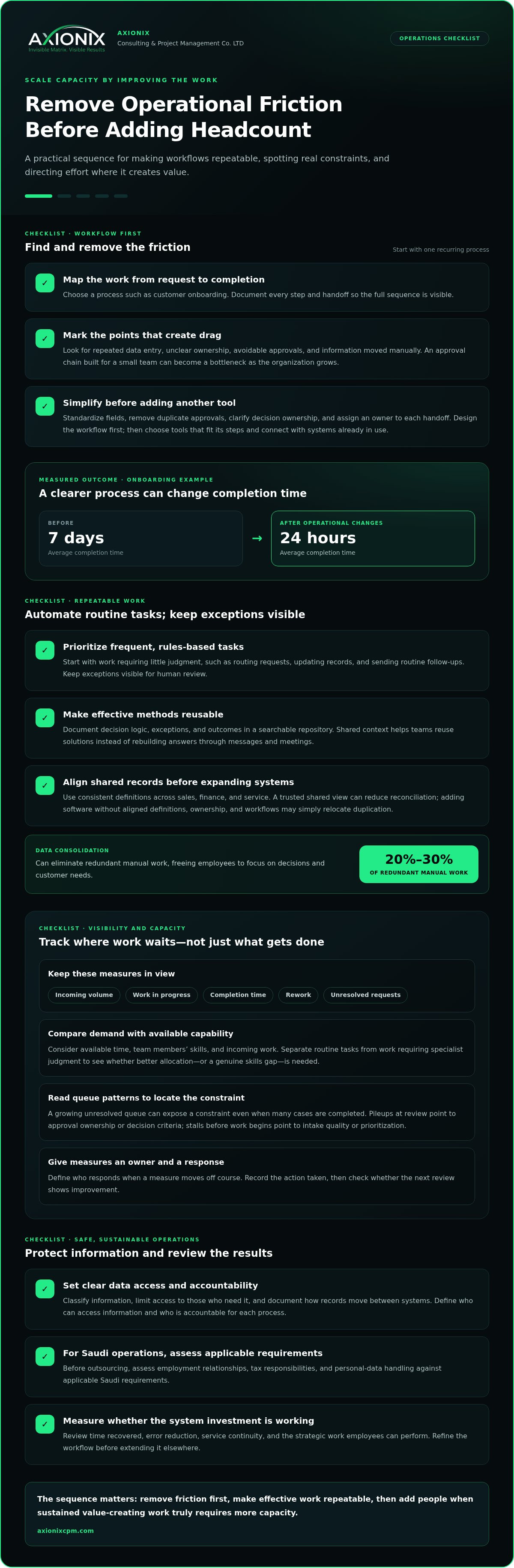
Adding people to a fragmented workflow increases handovers without fixing the underlying cause. Start with one process, such as customer onboarding, and document each step from request to completion. Note repeated data entry, unclear ownership, avoidable approvals, and information moved manually. An approval chain designed for a small team can become a bottleneck as the organization grows. Aim for a clear sequence that delivers consistent results without repeated explanations.
Which processes should be automated first to reduce workload? Start with frequent, rules-based tasks requiring little judgment, such as routing requests, updating records, and sending routine follow-ups. Keep exceptions visible for human review. In one onboarding example, operational changes reduced average completion time from seven days to 24 hours.
Choose tools only after designing the workflow. Map the process, then select tools that fit its steps and connect with systems already in use. A poor integration can move confusion faster rather than eliminate it. Improve current tools before adding another platform: standardize fields, remove duplicate approvals, and assign an owner to each handoff. Document decision logic so teams can reuse knowledge when onboarding people.
Protect data with practical steps: classify information, limit access to those who need it, and document how records move between systems. For work in Saudi Arabia, assess employment relationships, tax responsibilities, and personal-data handling against applicable Saudi requirements before outsourcing. Define who can access information and who is accountable for each process.
How much do automation and outsourcing services cost in Saudi Arabia? Costs depend on process scope, integration needs, data handling, and ongoing oversight. Compare these factors with the time and rework a change could reduce. How can AI improve productivity without hiring? Apply it to repeatable tasks, such as sorting requests or drafting reports, with human review for exceptions. To increase capacity without adding staff, remove duplicate work, clarify ownership, and redirect recovered time to higher-value work.
2. Compounding benefits of systems investment
A system creates value when it makes effective work repeatable. In 2026, businesses are advised to systematize, automate, or contract out suitable tasks before hiring. Start with a recurring workflow, identify where information is entered or transferred, then design integration that keeps records aligned. The value compounds when each completed task strengthens shared data and operating context, rather than creating another isolated record.
Data consolidation is a practical investment. It can eliminate 20% to 30% of redundant manual work, freeing employees to focus on decisions and customer needs. For example, align sales, finance, and service records around consistent definitions before producing additional reports. A trusted shared view reduces reconciliation and gives managers a clearer basis for allocating effort. Adding software without aligning definitions, ownership, and workflows simply relocates duplication.
Reusable knowledge compounds over time. Document decision reasoning, exceptions, and outcomes in a searchable repository. When a similar issue arises, teams can use established context instead of rebuilding an answer through messages and meetings. This turns individual experience into organizational capability and helps new team members contribute without relying on one expert to explain every recurring case.
For a Saudi business expanding across departments, a shared operating manual can standardize recurring approvals, reporting definitions, and service handoffs. Base it on the actual sequence of work, then assign an owner to maintain it as requirements change. This creates a repeatable foundation that can support more users and workflows without assuming every team works identically. Review access, data definitions, and exceptions whenever a process changes.
Measure system investment against time recovered, error reduction, service continuity, and the strategic work employees can perform. Review those measures after implementation, then refine the workflow before extending it elsewhere. To assess the operational case for system investment, evaluate the operational case before committing resources.
Recruitment agencies can integrate tools to reduce manual work, while searchable repositories preserve solutions. The UK Department for Education’s two-person ResearchOps team supports 10 to 120 researchers.
3. Dashboards, monitoring, and bottleneck visibility
A dashboard should show where work is waiting, not just what has been completed. Track incoming volume, work in progress, completion time, rework, and unresolved requests. For example, a service team may complete many cases even as its unresolved queue grows. That gap reveals a constraint that output totals alone can hide. Give each measure a clear owner and define how to respond when it moves off course.
Pair activity measures with capacity information. Allocating resources effectively requires visibility into available time, team members’ skills, and incoming work. A manager can compare the skills a reporting task requires with those available, then redirect suitable work before the queue grows. Separate routine tasks from work requiring specialist judgment. This helps show whether growth depends on better allocation or a genuine skills gap.
Monitor the full flow, from request to result. If requests pile up at review, examine approval ownership and decision criteria. If work stalls before it begins, look at intake quality and prioritization. A dashboard can show where delays cluster, but process owners need to interpret the cause. Record the action taken, then measure whether the next review shows improvement.
What risks come with scaling operations without hiring, and how can they be managed? Concentrated workloads can increase errors, delay service, and create dependence on a few experienced team members. Set capacity thresholds, monitor quality alongside volume, and redistribute tasks when queues or rework increase.
Introduce monitoring in stages. Start with one workflow and a small set of useful measures, such as queue size, the age of open work, and completion quality. Confirm that each measure has a reliable source and consistent definition, then review it with the people doing the work. Their insight can distinguish a temporary demand spike from a persistent bottleneck.
Use findings to adjust the operating model. If demand rises while capacity remains available elsewhere, shift assignments and clarify decision rights. If one approval step repeatedly holds up work, redesign it before increasing workload. A useful dashboard connects evidence to action, helping leaders decide whether the next improvement is better scheduling, clearer ownership, or added capacity.
4. Total costs of hiring and employee turnover
Salary is only one part of the operating cost of a hire. For a Saudi business, consider compensation, recruitment effort, onboarding, equipment, management time, and the work existing employees take on during the transition. Costs vary by role and operating model, so compare them with the specific capacity gap rather than treating headcount as a simple unit price.
Turnover adds another layer. Gallup and SHRM estimates place employee replacement costs between 50% and 200% of annual salary. Treat this as a broad planning reference, not a Saudi-specific cost figure. The mechanism is clear: recruitment and training consume resources, while colleagues cover work and institutional knowledge leaves with the departing employee.
Build a decision model around the role’s expected contribution. First, define the work the hire would handle and the volume remaining after process improvements. Then estimate the full employment cost over the relevant period, including ramp-up time and ongoing management attention. Compare that with the cost of improving workflows or integrating existing systems. Make assumptions visible so leaders can test how changing demand affects the decision.
Consider operational measures alongside financial estimates. If a team’s backlog grows while quality falls, additional capacity may be necessary. If the same team loses time to duplicate entry or repeated approvals, hiring could preserve unnecessary complexity. Review service quality, rework, workload distribution, and retention together. Lower staffing costs are not a success if delivery deteriorates or critical work becomes concentrated in one person.
Before approving a role, document the capacity problem, expected output, and alternatives already assessed. Revisit those assumptions after implementation; compare actual workload and delivery against the original case. This discipline makes the hiring decision more rigorous without treating every expense as avoidable. To assess workforce needs alongside process design, evaluate your operating model before committing to added headcount.
AXIONIX Consulting & Project Management: Operations as a Service (OaaS)
AXIONIX Consulting & Project Management provides Operations as a Service (OaaS) for businesses that need more operational capacity without building every capability internally. Its integrated operational infrastructure connects functions through a coordinated operating model, helping leaders address fragmented workflows and persistent execution gaps.
Consider this model when process changes cannot resolve a structural capacity constraint, or growth requires capabilities across several operational functions. Business Consulting and Transformation can support operating-model changes, while Feasibility Studies can help assess a proposed initiative before resources are committed. Start with the constraint the business needs to solve, not another layer of complexity.
To discuss your operational needs with AXIONIX Consulting & Project Management, visit axionixcpm.com.
Build the next stage into the operating model
Growth creates a choice: continue relying on improvised workarounds or establish an operating structure that can absorb change. Identify which capabilities must remain internal, which processes need redesign, and where integrated operational infrastructure can create continuity. Let the business’s strategy guide that decision, rather than an automatic response to increase headcount.
AXIONIX Consulting & Project Management Co. LTD offers Operations as a Service (OaaS), Business Consulting, and Transformation to organizations addressing operational structure and execution. These services help leaders move from diagnosing friction to shaping a more coherent model. The aim is not to avoid every hire, but to ensure each investment strengthens the system and builds lasting capacity.
If you’re ready to define an operating model for your next stage of growth, contact AXIONIX Consulting & Project Management Co. LTD. A deliberate design can help your business scale operations without hiring by default, while building a stronger foundation for the people and capabilities growth genuinely requires.
Frequently Asked Questions
How can a business scale operations without hiring more employees?
A business can increase output by redesigning how work moves across existing roles and systems. For example, a professional services firm can standardize project intake, reuse approved templates, and route routine client requests through a shared queue. Cross-training team members can also reduce reliance on one specialist. Keep human review for decisions affecting quality, customer commitments, or sensitive information.
How can outsourcing and freelancers help a business scale without permanent hires?
Freelancers and external specialists can support a defined project, seasonal demand, or skills gap without creating a permanent role. Before work begins, set the deliverable, decision authority, access boundaries, and handover expectations. For example, a business could engage a specialist for a one-off data migration while retaining internal ownership of customer relationships and operating knowledge. Keep accountability for outcomes clear.
How can businesses measure whether scaling without hiring is working?
Compare operational output with service quality and sustainable workloads. Track completed work, response delays, rework, customer feedback, and overtime together, since rising output alone can conceal strain. For example, if a service team closes more requests while complaints and reopened cases increase, the model needs adjustment. Review trends with process owners and link each change to a clear operating objective.